The established argument would have you believe that swearing in music shows a distinct lack of imagination. But a perfectly timed F-bomb can sometimes punctuate a pop song's message much greater than any cymbal crash or hooting synth loop. In the expletive driven genre of gangster rap, swearing is de rigueur. Effing and jeffing is seen as part of the vocabulary, not just to blithely move from one syllable to another, but to help emphasise a distinct aggression in the music, and underline a lifestyle of unapologetic dissent.
NWA's Fuck tha Police, for example, wouldn't quite have the same impact without the spitting venom behind it. Adam Buxton - one of today's greatest humans - did a skit in which he substituted the swearwords in Fuck tha Police to create his own song Help tha Police in order to protect the ears of his infant son, highlighting the absurdity of silencing this form of expression.
As as rule, they don't do this so much in, say, Australia, where the most offensive songs on Kanye West's last album were being belted out on the radio around the same time as Jackanory. You can't swear on UK broadcasts before 9pm, but it's perfectly fine to see a repeat of CSI: Miami in which the naked body of a drug addled prostitute is dismembered as you peer over the brim of your lunch box.
The best use of swearing currently circulating the BBC 6 Music playlist is the cuss-heavy misery thunk of John Grant's new record Pale Green Ghosts, which is a self-deprecating triumph and features, on GMF, the line "I am the greatest motherfucker that you're ever gonna meet". Bowing to BBC pressures, he has changed this to "I am the greatest living creature" for the radio edit.
But the song got me thinking about paying some motherflipping respect to other great uses of swearing in pop, from the vehemently angry break up song to the more subtle, scathing uses of bad language. Here's a purely arbitrary list of my personal faves, and if you don't agree, then in the spirit of Frankee, fuck you right back.
1. Eamon - Fuck It (I Don't Want You Back)
Eamon's bitter 2003 break up anthem reached number one around the world and sparked a reactionary follow up single, F.U.R.B. (Fuck You Right Back) by singer Frankee, claiming to be the ex-lover scorned in his angry diatribe. There's no truth to that, and anyway, a novelty hit is never particularly relevant or interesting the second time around. Eamon's retribution is a valuable lesson in the dangers of dating a pop singer in need of a hit record. The video shows the break up scene played out over a pepperoni pizza, using black and white flashbacks to show the extent of their former love which now lies torn, splattered and splayed, much like the meat on their pizza. "Fuck you, you ho, I don't want you back," he sings to her crying face. What on earth could she have done to inspire such grotesque hatred? Her infidelities are revealed in the second verse, but I prefer to think he was just fed up of eating pepperoni pizza.
2. Fatboy Slim - Fucking In Heaven
This sounds a bit dated now, which I never thought possible considering how cool British dance music was in the late 90s: Basement Jaxx, The Chemical Brothers, The Prodigy and this guy. Fucking in Heaven is an album track from 1998's You've Come A Long Way, Baby, sandwiched neatly between The Rockafella Skank and Gangster Tripping. I quite like the blatant use of repeating the sampled "fucking" element in this track - it's like some delinquent schoolboy constantly pulling at the pigtails of his classmates before being reported to the headmaster's office. Its juvenile, yes, but also quite funny. Mylo perfected this technique for Drop The Pressure in 2005, gloriously repeating the swear words to fit into a foul mouthed crescendo.
3. Cee Lo Green - Fuck You!
Another great anti-love song from the barbed but soulful bellows of Gnarls Barkley singer Cee Lo Green, who ended up landing a seat on the judge's panel of The Voice off the back of this viral 2010 hit. A Stevie Wonder-esque funk throwback co-written by bouncy soul munchkin Bruno Mars, this song started off being quite funny before it turned up absolutely everywhere. The radio edit unfortunately changed the words to Forget You, which detracts hugely from the song's comedic intent. Unlike Eamon, reeling in the mire of an existential crisis, Cee Lo's curses are directed towards his ex-girlfriend's new lover. In a cathartic remonstration, he resignedly admits his lack of finance may have been a contributory factor in their break up. "I guess he's an XBox and I'm more Atari", he sighs. The intention is to feel sympathy for Cee Lo's predicament, which on the face of it is clearly unfortunate, but in the video he's dressed like some pimped-out funk duke in spats and a Cadillac, so we're left in no doubt as to who got the last laugh.
4. The Beautiful South - Don't Marry Her
Using a swear word in gentle music can be explosive enough; now imagine the most innocuous band in the world doing it and the shockwaves echo to nuclear proportions. The original line to this great Beautiful South number is, "Don't marry her, fuck me". It's actually a wry dissection on the male midlife crisis and a telling indictment on how marriage is perceived from the sanctity of youth. After all, who didn't look at their life at one stage and wonder how much longer they could feasibly shirk responsibility before settling into an inevitable decline? Like the song says: "When your socks smell of angels but your life smells of Brie / Don't marry her, fuck me." Surely we must be ready for a reassessment of The Beautiful South's worth in light of their split five years ago? I love the reason they gave for breaking up: "musical similarities". Brilliant.
5. Rage Against The Machine - Killing In The Name
This angsty protest groove racket rioting against police brutality was made even more righteous when it somehow stopped X Factor winner Joe McElderry from reaching the Christmas number one spot in 2009. If Simon Cowell had a sense of humour he should have released a reactionary protest of his own, maybe endorsing a Killing In The Name cover using the X Factor finalists. The paradox of a pantomime troupe of wannabe pop idols screaming "Fuck you I won't do what you tell me" would have been glorious, but alas. I sometimes like to imagine Simon Cowell at a Rage Against The Machine concert, as Zach de la Rocha yells "motherfucker" over a crushingly violent guitar riff. But we can all guess what his reaction would be: "Sorry, but it's a no from me."
"Only a numbskull thinks he knows things about things he knows nothing about." The Hudsucker Proxy (1994)
Wednesday, 22 May 2013
Saturday, 19 January 2013
My Lidl Pony
The free Metro newspaper went with the headline, "Horses for main courses". The journalist Simon Hoggart told this joke: "I was in the Tesco caff for lunch and the waitress asked if I wanted anything on my burger. So I said, 'Sure, a fiver each way.'" My favourite was a text from my housemate. "What do you want for tea tonight? We could have those burgers I got from Tesco the other day but I checked the sell-by date AND THEY'RE OFF!"
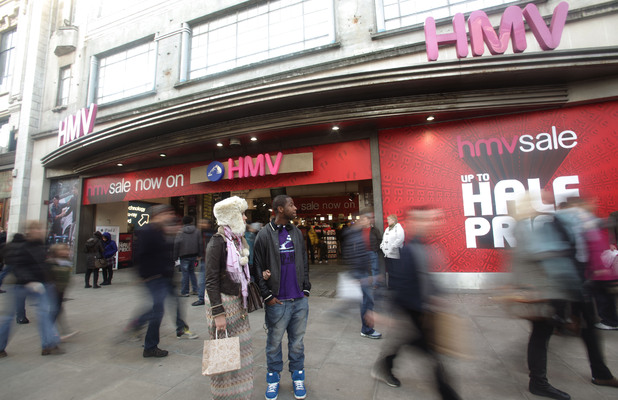
A friend of mine commented on the irony of a high street chain - nay, a "British institution" - which caused the steady decline of smaller independent record stores being usurped by the overwhelming empowerment of the internet. But I missed out on the quirky record stores you find in High Fidelity. We didn't really have that in Swindon, but we did have a HMV.
Not only was it a prime spot for social gatherings, but as a bored kid you could easily waste hours in there - rifling through the CD racks and movie posters, reading CD sleeves or listening to the latest singles. I knew every inch of that store. I bought my first CD single there (Seal's Kiss from a Rose).
I remember trying to buy Boom Boom Boom by The Outhere Brothers on cassette single, only to be refused by an intimidating assistant who had clearly heard the record and knew, at 10 years old, that I wasn't quite ready for that level of trash talk. I bought all my favourite boyhood punk albums there: Operation Ivy, The Sex Pistols, Green Day. When I was very young, I would rate other towns by the size and scale of their HMV stores. "Shall we go to Oxford today?" Mum might ask. "Yeah, their HMV is massive!"
I'm pining over a misspent youth as much as I am another failed high street chain. HMV remains a crucial chapter in the formative years of most people my age, which is why this closure hurts more than Our Price and Virgin Megastore put together. Now that music is no longer something you pick up, hold, read, save your pennies to buy or lend to a friend, the need for vast retail space is utterly redundant. Streaming software like Spotify is affordable, expansive and convenient. But where's the romance? With HMV's closure, those days are now well and truly mincemeat.
Labels:
burgers,
CDs,
Green Day,
HMV,
horse meat,
Metro,
Operation Ivy,
Simon Hoggart,
Swindon,
Tesco
Saturday, 12 January 2013
The Savile Report
His house overlooked Roundhay Park here in Leeds, and he could often be spotted jogging around its green surrounds or messing with the meals at his favourite local restaurants. He had just secured a new undergraduate training scheme to help junior doctors and nurses with their medical research, and I wrote a congratulatory, if slightly sardonic first-person appraisal.
Savile had been vocally supportive of our magazine since its inception. We had access to his mobile phone number and he was an obvious, if perhaps lazy, target for us to gather local celebrity comment. I initially left a voicemail asking him to call the office, which he did. I was away on lunch so he left a message with my colleague: "Tell him it's Robert De Niro, he owes me money."
It was a rocky interview. I remember his impatience at the fluidity of the questioning, his attempts to steer and control the interview. But he eventually thawed and spoke with nostalgia of "inventing DJ-ing" at the Leeds Mecca - or at least the notion of using two turntables - his phobia of technology and his thoughts on death. With his "pop pals" Elvis, John Lennon and Michael Jackson dead, there would be "one hell of a band in heaven."
If heaven exists it would now seem incongruous to find Jimmy Savile in it. Following the release of the Savile Inquiry, Deborah Orr in the Guardian described him an "evil genius". He controlled his eccentric public image as an affront to mask five decades of calculated sex crimes - abuse at 14 hospitals, over 450 allegations, 34 confirmed rapes and victims as young as 13.
In hindsight, we played directly into his hands - another ploy for his mass media manipulation. When Savile died his gold casket lay in state for the general public to pay their respects. Even in death he had the last laugh.
Like all bullies, Savile's cruelty was underpinned by intimidation on all levels, from the authorities investigating to the victims themselves. Many questions still need to be asked of those who saw the abuses take place and did nothing. The danger, says Orr, is that the Savile case will be seen as "entirely exceptional". The fallout from Savile should surely be that the voices of the abused are not ignored. Police failed to prosecute Savile during his lifetime despite a litany of allegations. It may take time to restore the confidence of victims of such abuse, but the Saville reports are a prime starting point.
Labels:
BBC,
Deborah Orr,
Downing Street,
Jimmy Savile,
The Guardian
Saturday, 29 December 2012
The Toxic Math Christmas Special
Trying to get out of York was interesting, as the station descended into the sort of deranged madness you find in disaster films. Trains - the ones that actually existed in a recognisable, tangible sort of way - were running chaotically late. Shoppers laden with bottles and bargains were left staring at digital billboards as their limited holiday time drifted away. I got on the 1357 to Manchester Airport about 20 minutes after it was due to depart. The reason for the hold up: "We apologise for the late running of this First TransPennine Express service to Manchester Airport," a stoic voice declared, "but our driver hasn't had his break yet." During the season of goodwill one has to be charitable.
Another year, another cunning attempt to disguise the taste of sprouts. Hugh Fearnley-Whittingstall is a firm traditionalist who steams his sprouts with whole garlic. We whipped a spoon of Boursin cheese into ours, but people do all sorts: whipped and sliced and blended beyond all recognition. Of course if you don't like sprouts to begin with then I suggest simply replace the sprouts with something you do actually like. On Christmas Day, we had a French feast including foie gras, champagne, saucisson and anchovies, duck legs and ratatouille. I had never eaten foie gras before - the tins had been secured by our French friend via Saint-Tropez. The taste wasn't too dissimilar from most liver patés and not overwhelming enough to warrant the cruelty involved in its production. But try telling that to the French.
Labels:
churches,
foie gras,
Hugh Fearnley-Whittingstall,
iPod Touch,
sprouts,
Thundercats,
York,
York Minster
Sunday, 23 December 2012
Top 5 List of Lists of 2012
Everyone likes a neatly compiled end-of-year list at this time of year – the end of it. But how can you possibly decipher the best lists from so many other lists out there? Well, TM has the answer: you need a list, of course.
5. The Top-Earning Dead Celebrities of 2012
Forbes had the foresight to compile this list back in October, presumably hoping that Donald Trump wouldn’t keel over in the interim. This puts big-spending silver screen luvvie Liz Taylor on top of the list for 2012's wealthiest dead celebrities. She earned US $210 million this year. An auction of her extravagant belongings by Christie’s brought in $180 million of that. A staggering sum, but then she did own pearl necklaces from the 16th century and an original Van Gogh. Death has certainly proved to be a wise investment for Michael Jackson. He was promptly signed to a new album deal by his old record company, Sony, which is quite an achievement, especially after he called them all racists. My sympathies go out to any aspiring young bands who would have loved an album deal only to have lost out to a dead guy. Jacko stacked up $140 million in 2012. Jackson’s former father-in-law Elvis Presley is third on the list, earning $55 million. Just think how many cheeseburgers you could buy with that?
4. The 140 Best Twitter Feeds of 2012
Time’s tech team took time out, it seems, to compile a list of the Twitter feeds which are “shaping the online conversation”. I’m not too sure how you go about shaping a conversation. My guess is that it has something to do with thinking outside the box. In order to compile a list like this you clearly need to be wrestling with an alarming Twitter addiction. This was the year microbloggers seemingly lost the connection between their brains and their finger tips. I’m looking mostly at professional footballers and Sally Burcow here (pictured), but quite a few big organisations have needed to brush up on their social media skills this year. Like the NRA, who tweeted “Good morning, shooters. Happy Friday!” the day after the Colorado cinema shootings. Inc. have put together the 7 Worst Tweets of 2012 which is another great list full of more abhorrent tweeting, corporate cock-ups and #epicfails.
3. 10 New Words of 2012
The Telegraph have fun compiling 10 new words which have really got up their nose in 2012. Without sounding like too much of a pedant, most of these aren’t technically new words but portmanteaus and acronyms. “Amazeballs” isn’t mentioned here, before you go looking for it. Although a derivative it deserves to be a new word on the basis of making absolutely no sense. Instead, The Telegraph hate “shamazing”, coined by X Factor judge Nicole Scherzinger and then repeated by David Cameron, but then she could have said “shamazeballs” which would have been truly awful. I would still like to see David Cameron say that one. “Mr Osbourne, your Budget reform speech was totes amazeballs,” adding, “I am well jell.” According to Fiona McPherson, senior editor at the Oxford English Dictionary: “In a decade’s time, some will still be around, while others are year-specific. We’ll look back and ask, 'What was that all about?’” We can then put all of this down to one giant omnishambles.
2. Pitchfork: Best Albums of 2012
Ah, Pitchfork. Where would we be without your literary, lefty, trendsetting ways? Still listening to Steps, presumably. Pitchfork is the only music website where you can read a review on ambient glitch hop and know even less after reading it. Their opinions set the playlist for most iPod’s these days, which means Kendrick Lamar (number one and pictured) can expect a big bump in his Spotify ratings. But sorry, have you actually heard the Swans album (number five)? It’s really hard work. It sounds like a hellish ambulance ride sludging its way to the Jim Morrison Funny Farm. Stuart Berman writes that after hearing the album, “you’ll feel physically and emotionally exhausted.” That’s how Pitchfork recommend things. While I’m offering unsolicited opinions, my favourite song of the year is Lone Wolf’s The Swan of Meander. It’s a gorgeous, enveloping and textured swoon which imparts some new hidden delight every time I hear it. He’s touring soon, too.
1. Top 10 Celebrity Mysteries of the Year
I thought I would have a stab at solving some of E!’s celebrity mysteries of 2012. I glanced over a copy of Now! at the hairdressers the other day, so I think this makes me uniquely qualified. “Why can’t Lindsay Lohan stay away from clubs?” Because they are great places to relax and have fun. “When will Brangelina marry?” Next year in a very private ceremony which will not be widely reported by unctuous gossip hounds. “What did we really find on Mars?” A Starbucks. “Why does Taylor Swift keep dating high school boys?” Because she needs their coursework, hair products and skinny jeans to create a highly potent substance which gives her special singing powers. “What is inside the royal womb of Kate Middleton right this very second?” A baby.
Forbes had the foresight to compile this list back in October, presumably hoping that Donald Trump wouldn’t keel over in the interim. This puts big-spending silver screen luvvie Liz Taylor on top of the list for 2012's wealthiest dead celebrities. She earned US $210 million this year. An auction of her extravagant belongings by Christie’s brought in $180 million of that. A staggering sum, but then she did own pearl necklaces from the 16th century and an original Van Gogh. Death has certainly proved to be a wise investment for Michael Jackson. He was promptly signed to a new album deal by his old record company, Sony, which is quite an achievement, especially after he called them all racists. My sympathies go out to any aspiring young bands who would have loved an album deal only to have lost out to a dead guy. Jacko stacked up $140 million in 2012. Jackson’s former father-in-law Elvis Presley is third on the list, earning $55 million. Just think how many cheeseburgers you could buy with that?
Time’s tech team took time out, it seems, to compile a list of the Twitter feeds which are “shaping the online conversation”. I’m not too sure how you go about shaping a conversation. My guess is that it has something to do with thinking outside the box. In order to compile a list like this you clearly need to be wrestling with an alarming Twitter addiction. This was the year microbloggers seemingly lost the connection between their brains and their finger tips. I’m looking mostly at professional footballers and Sally Burcow here (pictured), but quite a few big organisations have needed to brush up on their social media skills this year. Like the NRA, who tweeted “Good morning, shooters. Happy Friday!” the day after the Colorado cinema shootings. Inc. have put together the 7 Worst Tweets of 2012 which is another great list full of more abhorrent tweeting, corporate cock-ups and #epicfails.
3. 10 New Words of 2012
Ah, Pitchfork. Where would we be without your literary, lefty, trendsetting ways? Still listening to Steps, presumably. Pitchfork is the only music website where you can read a review on ambient glitch hop and know even less after reading it. Their opinions set the playlist for most iPod’s these days, which means Kendrick Lamar (number one and pictured) can expect a big bump in his Spotify ratings. But sorry, have you actually heard the Swans album (number five)? It’s really hard work. It sounds like a hellish ambulance ride sludging its way to the Jim Morrison Funny Farm. Stuart Berman writes that after hearing the album, “you’ll feel physically and emotionally exhausted.” That’s how Pitchfork recommend things. While I’m offering unsolicited opinions, my favourite song of the year is Lone Wolf’s The Swan of Meander. It’s a gorgeous, enveloping and textured swoon which imparts some new hidden delight every time I hear it. He’s touring soon, too.
I thought I would have a stab at solving some of E!’s celebrity mysteries of 2012. I glanced over a copy of Now! at the hairdressers the other day, so I think this makes me uniquely qualified. “Why can’t Lindsay Lohan stay away from clubs?” Because they are great places to relax and have fun. “When will Brangelina marry?” Next year in a very private ceremony which will not be widely reported by unctuous gossip hounds. “What did we really find on Mars?” A Starbucks. “Why does Taylor Swift keep dating high school boys?” Because she needs their coursework, hair products and skinny jeans to create a highly potent substance which gives her special singing powers. “What is inside the royal womb of Kate Middleton right this very second?” A baby.
Thursday, 15 November 2012
Telly Ache
When you’re unemployed, simple daily tasks take a lot longer.
Breakfast lasts for three courses. A shower becomes Homer’s Odyssey. And
daytime television is the procrastinator’s sworn nemesis, because the
demoralising truth is nobody has ever achieved greatness by watching four back
to back episodes of Come Dine with Me.
I had this epiphany during an episode of Homes Under the
Hammer. It’s not even a bad show, but it has this hypnotic, repetitive, anaesthetic
appeal that numbs your synapses, mushing your brain into a property pulp,
washing over you like some innocuous fart. It’s the
television equivalent of staring into a coal fire or a washing machine. It’s
just there.
The show fits perfectly into UK TV’s daily dump of daytime
discharge. The only reason you would voluntarily sit and watch Homes Under the
Hammer is if you were infirmed, being kidnapped, trapped under a coffee table
or hopelessly unemployed. There are currently 2.51 million people unemployed in Britain. The ratings must be huge.
I wouldn’t have thought the TV map could change so much in my two and a half year absence from these British
Isles, but who could have guessed the current godlike deity status
of Gary Barlow – an ex-Take That singer - or the fact a comedian like John
Bishop could sell out the O2 Arena. To my ears, he still sounds like a darts
player.
Speaking of The X Factor, there now seems to be an Essex version of Cheryl Cole sitting in Cheryl Cole’s
seat. I actually thought it was Cheryl Cole for a minute, probably miming. Not
that she would do that, of course.
Sardonic Apprentice underling Nick Hewer was an inspired
choice for Countdown. He gives the droll impression that the show is constantly
distracting him from a horse race at Cheltenham.
I like it when he has to interview his guests and forgets to stop talking after
he’s asked a question. Out of all the pseudo-celebrities enjoying partial
acclaim when I left the country, Nick Hewer’s ascendance to daytime stardom is particularly
puzzling. What’s next? Bargain Hunt with
Duncan Bannatyne? Loose Women with Ann Widdecombe? Daybreak with Aled Jones? Hold on, that last one appears to have actually happened.
When I left the country condescending bear-baiter Jeremy
Kyle was being hauled over the coals for exploiting the vulnerability of his
guests. His reward: an American version of his TV show and seemingly 24 hour
rotation on ITV2 (now to renamed Irritating TwatVision 2, or something). He has probably been
given a pay rise and made Head of Pernicious Programming. Give it a year and he’ll
be running for London Mayor.
I always wonder whether anything good comes from these programmes.
Do you think the guests leave saying, “Thank you Jeremy for that insightful and
at times physical debate. Following the lessons we have learnt today and under
your insightful guidance we hope to go on with our lives in a more
positive and compassionate manner. Particularly now the DNA test proves the
baby is Darren’s. Thanks.”
Noel Edmonds’ new fuller beard is fascinating. With his floral
shirts and tumbling locks he looks like a seventies version of Aslan. Deal or
No Deal still deserves some credit for making the opening of a box look like a
courtroom drama. It has been on nearly every day for seven years now. Seven
years, for Christ’s sake. Richard Osman, of Pointless fame (more on that in
a minute), said in this article that Deal Or No Deal is not about luck, but rather
knowing when to quit. “It is essentially ‘stick or twist’ in the same way as
any job or relationship you’ve ever had is,” he writes. “What man, when his
mind turns to marriage, hasn't thought: ‘It's a lovely offer, but perhaps I
should just open three more boxes?’”
Breakaway is a particularly lumbering,
drawn-out quiz show where conceited one-upmanship is rewarded over coalition.
Individual contestants can ‘breakaway’ from their team to answer questions on
their own and therefore gobble up all the prize money themselves. There is a
political and social metaphor in this. Host Nick Hancock is tolerable but
a little patronising. “Now are you sure
you want to do that?... They were really
tough questions weren’t they?”
My favourite daytime quiz show is now BBC1’s Pointless,
hosted by the always-affable Alexander Armstrong and the aforementioned Osman.
The format is a loose appropriation of Family Fortunes, where
contestants find the least likely answers based on the most common responses to
audience surveys. So, for example, you probably know that Australia is a country beginning with A, but
then a country like Antigua
and Barbuda, which also begins with the letter A, may have slipped your mind. Pointless answers are ones that are both correct and so
obscure that nobody in the survey thought to mention them.
It’s a quite cynical concept, really, having to second guest
the ignorance of the general public. I always wonder where they find the time
and the people to question for these surveys. But with so many out of work it’s
obvious. You can probably do it by pressing The Red Button. During Homes Under
the Hammer, no doubt.
We saw Singin’ in the Rain at the Palace Theatre in London's West End last week and what a
jolly thing it was, heightened somewhat by exceptional seats within splashing
distance of the stage. The gags are 60 years old but still great,
and actress Katherine Kingsley has a ball playing verbally-challenged silent
screen diva Lina Lamont, elaborating on Jean Hagen’s screechy
drawl with ear-splitting aplomb. Director Jonathan Church gives both Lina
and Kathy more stage time than Gene Kelly ever did in the movie. Here they even
get their own songs. I never quite bought Kathy’s sudden infatuation with the
enigmatic yet egomaniac Don Lockwood. Here she is given pivotal
breathing space to assess the merits of dating a megastar with a licentious
reputation.
Singin’ in the Rain works because of its
celebration of movement (a universal language) and the basic premise celebrating the
magic of cinema, something everyone can share. It may be the most
damn near perfect film about films ever made, but it was conceived as a comedic
throwaway to string together the hits of MGM songwriters Nacio Herb Brown and
Arthur Freed. Gene Kelly considered his greatest work to be An
American in Paris, filmed the year before. The
extended all-dancing Broadway finale which concludes SITR was a formula copied
from Kelly’s mammoth ballet sequence at the end of An American in Paris. The film also just about killed the
musical as a viable money-spinner in mainstream cinemas, as rock and roll
rebels and the rise of independent film all but killed off the studio system
and the big budget musicals they championed.
But watch the show, it’s a triumph. However, a word of caution; expect to get a bit wet in the first five rows. The cast use the final 10 minutes for a vengeful, stomping splash-around as the stage is flooded and the audience duck for cover. Some people actually brought umbrellas, which was a nice touch.
Tuesday, 16 October 2012
Sun, Sea, Sex and Sangria: A Weekend in Benidorm
Sticky Vicky's reputation precedes
her. The things she can do with a ping pong ball will make your eyes water. I
won’t go into too much detail on a family website like TM, only to say her routine is not restricted solely to ping pong. According to this, unfeasibly
larger items like glass bottles, giant candles,
light bulbs and, more disturbingly, razor blades. For her festive show
she produces a Christmas tree. I wonder what she does for an encore?
Now approaching 70 (yes, 70), Sticky Vicky
has been performing her act to shell-shocked tourists for over 30 years. She
continues her seven-day-a-week grind to his day. She has now enlisted the help
of her daughter who opens the show with an acrobatic magic act before her mother
takes to the stage and takes her clothes off. And this is only one of the “attractions”
on offer amongst all the seedy nightclubs touting “lesbian shows”, the free-entry
all night “disco-pubs” and reams of tribute acts (Peatloaf, Michael Bauble, and
so on), all centered along the notoriously chaotic confines of the so-called Yellow Brick Road. But we are a long way from Kansas. Welcome, then, to
Benidorm.
To be fair, the Spanish coastal town has
always been sex obsessed. In May this year Benidorm celebrated the 60th anniversary of then-mayor Pedros Zaragoza’s decision to legalise the wearing of
bikinis.
The decision was reached after a British woman was fined 40,000 pesetas for wearing one at
a beach bar. In fear of losing the town’s appeal as a
frisky tourist cash cow - especially at a time when the local fishing industry
was fractured - Franco’s fascists turned a blind eye. Which is more than can be
said about the tourists. Benidorm welcomes five million of them every year, all
in search of sun, sea, sex and sangria.
But now in 2012, is Benidorm finally suffering
the hangover from 60 years of hedonistic overkill? The east coast of Spain has
suffered dramatically from the fallout of the noughties Spanish property boom and
the subsequent Eurozone crisis. This is evident from the
number of derelict bars you can see, and the building projects abandoned
mid-construction. Now there is a genuine fear the cranes might
collapse, like they did a couple of days ago near Sotogrande on the Costa del Sol. According to an engineer questioned on the
Olive Press website: “Because they are so close to the sea, the salt in the air is eroding the
cranes much quicker than would be the case with structures further inland.” A
disconcerting thought.
And do I denote a touch of chippiness from
the harassed, overworked bar staff? One cafe refused to put onions in their cheeseburgers
because it “stinks the place out”. It’s hard to argue against something like
that. Another sounded her frustration at the thought of replacing specific elements of the “large breakfast” option. Her reaction seemed to suggest I had asked her to solve the
Spanish debt crisis rather than put a spoonful of baked beans on a plate. I sensed she was clearly someone in desperate need of an escape.
The tourists are older here, too. Following
the packaged tours of the 1980s and the subsequent violence that ensued, younger revelers decided to forgo the hen and stag parties of Benidorm for the burgeoning
bedlam found in Ibiza and Malaga. There's a running joke in the ITV
comedy series Benidorm about this,
where the elderly cantankerous Madge barges her way through the busy streets on a
mobility scooter without actually needing to use one. Wheelchairs and scooters
rent from 20 euros a week. The flyers are everywhere.
But coming to visit for a long weekend
outside the July-August peak season, everything seems business-as-usual. The popular
TV show has no doubt helped to further promote the town in the minds of overseas travelers,
and I found the beaches friendly and well maintained. Surprisingly, there are actually
some very pretty aspects to Benidorm. I loved the views from the church of San Jaime and the charismatic side-streets and market stalls of the Old Town, like a scene straight out of
Granada, and the epic, seemingly endless mountainous surrounds to the west which
so define the landscape in this part of Spain. The joy in overlooking a vast
ocean vista with caffe con leche and tapas on a glorious day is surely one of
the world’s greatest pleasures. No wonder the Spanish don’t get any work done.
The old town is also the best place to take in
the full scale of Benidorm’s 6km radius of revelry. Since the 1960s, the playa has become a
breeding ground for hotels to rise indiscriminately into the sky - the tallest at
186 metres. But now there is just no escaping the colonising British, as they liberate their
minds - and most of their stomach contents - from the cold, workaday routine of
life back home. As a result, Benidorm has taken on the puzzling moniker of a
“home away from home” for the Brit – the kind of place they can relax without
having to concern themselves too much with any of that foreign stuff.
This manufactured paradise comes at a cost:
the ugly flipside of our drinking culture is not a British trait
which serves us well, particularly abroad. Benidorm takes
every rebellious, binge-drinking, kebab-chewing Saturday night you’ve seen
in Leeds, or Bristol,
or Blackpool or just about anywhere and spits it right back at you on a regular basis. No wonder the locals have scarpered to the hills.
Now there is talk of a 5am curfew to give
the authorities time to “clean up the empty bottles, the rubbish, the vomit”, according to an article in the free Round Town paper. But 5am
seems pointless, like shutting the stable door after the horse has
bolted. Another tactic may be fining promoters up to 60,000 euros for organising
bar crawls. “It’s an unforgivable image,” says Paco Carrasco, owner of a chain
of nine pubs. “Nobody wants to be heading into work, or down for an early
morning walk on the beach to be confronted by… a group of loud drunks.” I would
agree, but then is there anything more British than complaining?
Labels:
Benidorm,
bikinis,
binge drinking,
Britishness,
Eurozone crisis,
Sticky Vicky
Wednesday, 9 May 2012
Beached As
I think I should explain this photo. A full body spandex
wet suit – costing all of seven dollars – may cause you to resemble a gimp on
spring break, but it can also stop you from becoming fish food; struck immobile
by any number of stray stingers proven to inflict prompt, swift, grievous
bodily death. This is something our lifeguard Zack “can’t stress enough”. Two
weeks ago a man was hospitalised within an hour after meeting the acquaintance
of a bluebottle jellyfish. A Lycra wetsuit is therefore the easiest seven dollars
Zack will make all day.
During our pre-snorkelling debrief (and I can’t stress the
word brief enough, particularly for
someone whose closest memory to deep sea diving was picking up a brick from the
bottom of a swimming pool about 15 years ago), there is a lot of information that
Zack “can’t stress enough” – an overwhelming list of catastrophes to put the
willies up any Great Barrier novice. It may be one of Earth’s most beautiful sites
(the world’s largest coral reef system stretching to some 1600 miles) but the
challenge makes us fearful like gladiators at the Coliseum.
Coral may be beautiful to look at, but don’t for heaven's sake stand on it,
even if you panic. Hard coral can cut, leading to possible infection upon which
your leg will be summarily donated to marine science for research purposes.
Because of May’s Super Moon, the tide is so low the coral lingers close to the
surface. This makes the likelihood of entrapment very high. “Snorkel around the coral,” Zack says. “I can’t
stress that enough.”
Leave only with photographs, we are told, and don’t remove
any of the coral. Swim within the
buoys. Don’t wave to friends while in the water. Don’t graffiti your initials
on the shell of a green turtle. Don’t chase a giant trevally into the baying path
of a nearby reef shark. He may not have said those last two, but fear had taken
hold by this point and creating its own imagery. The Aussie adage of “no
worries” did not seem to apply here on the reef. There seemed to be plenty to
worry about.
I got the hang of breathing without asphyxiating quite
quickly, although much of the experience was bewildering. Humans may make
passing impressions of marine life but we paint quite a pathetic picture,
really, and betray our aquatic ancestry. You can’t help but get the impression
any passing turtles are having a tremendous time observing the flailing
spectacle from the ocean’s murky depths. I bet they gather on the coral in
groups and piss themselves laughing.
The tide pushes me over a particularly dense section of
coral and for a moment I’m awestruck – a mass of gently pulsating, bleak tentacles seemingly drawing me in, closer. Quite frightening, really. As for
observing the sea life, the glass bottom boat was more successful. “How did you
not see a turtle?” says one of the
crew. I think I was trying not to swallow my own body weight in salt
water. Sorry, sir.
The Low Isles – where we are – are a coral cay on the outer
reef encompassing hard coral, which means we won’t see the more colourful
stuff they show on the adverts. That’s fine with me. Low
Island is a paradise which will
take a child two minutes to run around (I overheard this fact). It is an hour
boat ride from the Australian mainland. It has a lighthouse and a cabin for the
island’s only inhabitant – a caretaker – which is obviously a job which comes
with its own perks. Day trippers anchor yachts near the giant
catamarans which shuttle tourists into the reef on a daily basis. Queensland
University has a base here for its
marine biologists and it’s clear to see why. The reef contains 1500 species
of fish, 5000 species of mollusc, 2195 known plant species. Nine different
species of seahorses live here. Nine.
They can also keep a close eye on how quickly the whole
thing is disappearing. The reef is pretty high on the Things to See Before You
Die list, or rather, Things to See Before They Die, followed closely by watching the Rolling Stones. Since the 1920s,
rising sea levels have seen Low Isle shrink by 20 per cent. Then there is coral
bleaching caused by an imbalance of algae in the warmer waters. At this rate,
the Great Barrier Reef could be extinct within a hundred years.
Evelyn, a superior sea faring intellect, takes our bushy
tailed troupe around the exposed coral. She’s a master of the Australian
understatement. She spots a tourist trampling over the bay in the
faraway distance and spares no sympathy; he’s exposing himself to injury from
conefish, stingrays, jellies and other nasties. “People don’t listen to me,”
she sighs. She tells an American tourist not to touch a sea cucumber (pictured opposite) – a spectacularly inert object from the starfish family which can eject a harmful
toxin from its phallic like body – to which the man responds by running his
fingers across it. Her frustration is palpable.
Someone spots a sea snail – an unassuming shelled creature
about the size of an old 50 pence coin. Evelyn explains the creature can render a
human quite redundant in less than 60 minutes. My thoughts go back to the lone traveller
in the distance and I wonder what’s worse: the fear of instant paralysis or an
almost certain bollocking from Evelyn. Given her current state of mind, I’d
take my chances with the conefish.
You shouldn’t joke, really. This is, after all, the part of
the country where Steve Irwin was killed, struck in the heart by a stingray. Appropriately, we were
told this fact after our snorkelling
session. Evelyn said, with more than a hint of pride, that tropical North
Queensland “has them all” in terms of flying, crawling, biting,
stinging, killing things. This is where, only last week in the Daintree
rainforest, a golden orb spider was filmed eating a tree snake. I should
probably repeat that. A spider eating a
snake. You don’t need to try and picture the ghastly scene, because
you can see it here on YouTube.
A park ranger in the Daintree casually stands by the biggest spider I have ever
seen, relishing in the story of how the males are devoured by the females after
mating. Woody Allen would have now made a joke here about how much this reminds him of an ex-girlfriend. A ranger at the Daintree says she loves her job in the forest and how it’s better than an office job, although you do have to put up with
snakes. Not too dissimilar from journalism, then. Ba-doom.
From the Skyrail you can see the vast expanse of rainforest
which meets the sea and the sky beyond, and the views are breathtaking. Stomach
churning, too, if you’re no keen lover of heights. The Skyrail reaches 1788ft at its highest point. Packed
into a cart no larger than a fridge-freezer, the cable car actually sways in
the wind. Sitting on the floor of the car won’t help you either, because you
can still see the tops of the trees through the flooring; designed, seemingly,
to give all the vomit a chance to escape.
But the views are insane, and just about the only place in Australia
where you can see anything like it, including the township
of Cairns and the reef islands
beyond. We had already fallen in love with the place by this point – the cheese
selection in the Port Douglas Coles had put paid to that.
Port Douglas is sea village with an easy,
Byron Bay
attitude with some of the best restaurants I have ever visited and absolutely no
pretensions, because the environment speaks for itself. Bill and Hillary
Clinton spent their wedding anniversary here, and Bill must just love the place. He was eating in the sublime Salsa restaurant on September 11, 2001, and just had time to sign a dinner
plate before a plane hit the north tower and he was promptly evacuated from of Australia.
But the ranger was right. I would choose the snakes, too.
Wednesday, 16 November 2011
Kind of Blue
A radio microphone can be deadly in the wrong hands. For our ten hour round trip to the bewildering Blue Mountains – New South Wales’ sprawling eucalyptus rainforest 260km (161 miles) west of Sydney – a rabble of English, Scottish, Swedish and Japanese tourists unknowingly form a captive audience for the idle chatter of Nick the bus driver. As a burly, knowledgeable scout leader, he would be played by Brendan Gleeson in the film version, doing his best attempt at resigned, quiet contempt. Nick’s gift for rhythmic, hypnotic narration has been perfected over the years to resemble that of a soothing day nurse: it’s the sort of measured tone you need when you’re administering some form of heavy sedation.
But then you’re catapulted back into a gift shop so quickly that it’s as if the violation was just some scary nightmare. Too quickly, actually, as we soon found ourselves away from Nick’s grasp and with time on our hands. This is where we tend to resort to a brand new game where we think of alternate messages to write inside the wrappers of Mars Dove Chocolate Promises, which usually contains trite and nonsensical whimsy like, “Money talks, chocolate sings” and, “Too much of a good thing is wonderful”. I personally can’t wait for the day when a disgruntled Mars employee rolls into work and replaces all the messages with things like “Have a shit day” and “Go fuck yourself”.
After an hour of staggering through Sydney’s ceaseless traffic and suburbs (over 600, apparently), it quickly becomes apparent that Nick’s patience for the job exhausted many years ago. Although he’s impossible to ignore, threads of monologue seep through, like when you're skipping through the stations on an AM radio. From Nick’s take on Sydney’s infrastructure crisis to predicting the weather forecast, the next thing I remember hearing was about the research into his family tree. “Fire destroyed the records… so many facilities these days… traced back to the 1500s…”, and then later, “You may be an adult but you’ll always be my child.” I suddenly started to envy the Malaysian lady in front of us for not being able to understand English. “My son’s six foot one… seriously, 30 years of age and he won’t leave home…” And so it went on, and on, and on.
The weather is a concern, of course. If cloud sets in over the mountains then visibility from the designated viewing platforms will be seriously limited, particularly the one over the fabled Three Sisters - a famous procession of three tall rock formations. But then the Blue Mountains has always been regarded as a world onto itself: encompassing over 4400 square miles of dense, fiercely unremitting terrain, the valley resembles a boundless sea of green from the higher reaches with gorges some 760 metres deep, and is practically impenetrable from the inside. This would have been the view for those first European settlers who within 25 years of claiming Sydney had expanded so far north and south (to the natural boundaries of the Hawkesbury River and the Royal National Park in the south) that the only route left for development was west, directly into the path of the mountains.
Kent born farmer and wine maker Gregory Blaxland is credited as the first European settler to cross this dividing range, leaving in 1813 with fellow explorers William Lawson and William Wentworth, and “attended by four servants, with five dogs, and four horses laden with provisions, ammunition, and other necessaries,” according to his diaries. The expedition only succeeded after the team listened to the advice of the local Aborigines who directed them to higher ground and to avoid the dry river beds, which had led so many previous expeditions into complete disaster. So formidable was the fear of the forest that prior to Blaxland’s successful crossing, the Blue Mountains were regarded as the ultimate deterrent for any escaping convicts. At ground level it’s easy to see why: not only is it vast, sheer and dense, but it all pretty much looks the same.
People still get lost in it today. In 2009, a nineteen year old backpacker from London left a Katoomba hostel on a 10 mile hike and wasn’t seen for 12 days. While living off seeds and berries, a team of 400 people fought through thick fog and bitter temperatures in the height of a New South Wales winter to try and locate the boy. His father was clearly less than sympathetic when he was finally reunited with the boy: “I can’t say I’d kill him because it would just spoil the point of him being back,” he said to the press. “But I'm going to kick his arse.” According to Nick, the teenager, called Jamie, was originally part of one of his tours. Once we had reached Katoomba ourselves and had been released from another one of his inane ramblings, I can easily understand why Jamie chose this point of the trip to quickly make a dash for it.
Katoomba is an idyllic township which now shuttles tourists deep into the bowls of the valley thanks to a couple of ingenious methods. One is a hair-raising cable car some 200 metres high, which is obviously quite unnerving, but positively breezy compared to the alternative: the World’s Steepest Railway. This train drops you down 415 metres of track from a nearly sheer cliff face at an angle of 52 degrees at the sort of white knuckle pace that could only ever have been designed for freight, rather than, you know, humans, with families and respiratory systems.
Upon the discovery of coal in the range, Katoomba became a key mining town from 1878 until the late 1930s, despite the mines being located in possibly the most awkward place on the planet. But human endeavour is never stronger than when commerce is concerned, so the staggeringly powerful train dates from roughly the same period, used to transport coal from the valley depths where some 100km of tunnels wind their way through the rock, all picked and blown and smashed by hand. We travel backwards up the thing in a practically vertical state, dragging us to the top of the mountain like some strange train wreck in reverse. It’s completely terrifying.
While dozing on the way back into Sydney, Nick effortlessly relies on his successful capability of disengaging his mouth from his brain to keep his passengers awake. I distinctly remember regaining consciousness at one point and hearing, “…the standard procedure is to take on as much ballast as you can,” before trying to think of more messages to write inside chocolate wrappers. “You’re going to get fat” seems somewhat appropriate.
Labels:
Blue Mountains,
Katoomba,
Sydney,
Three Sisters
Friday, 22 April 2011
The Rock Show
Our Virgin Blue Embraer E-Jet 170 plays a risky game of chicken with a neighbouring aircraft as we start our descent into Sydney, like Saturday shoppers racing for the same park. Clive James said that “nothing should be allowed to detract from a proper celebration of that first, and continuing, impression of Sydney and its harbour,” but the heady mix of both goading and plummeting was distracting. James continues: “It remains one of the Earth's truly beautiful places,” and “the place is too multifarious to be captured by the pen.” But then he was born there. We rubberneck to see vanishing views of “Venice without the architecture, and more of the sea,” of bridges and beaches and schooners and a pointy opera house, but we’re efficiently parked before the scene can truly settle. This is our last glimpse of the blues and greens of Earth before our trek “through the guts” and into a contrary, arid Martian otherness.
Virgin Blue don’t fly direct to Ayer’s Rock Airport from Brisbane, so your flight south to Sydney takes one hour and ten minutes, followed by a journey northwest of three hours and thirty minutes: a combined travel time of four hours forty minutes. Leaving from London Heathrow, you could travel to Cairo in roughly the same time. Looking down over endless tracts of land - seemingly uninhabited, unperturbed and increasingly unremarkable - the sheer scope of the ground below takes on a breathless uniformity. Although we were only stopping halfway across the country, this is a scene that goes on. And on. And on.
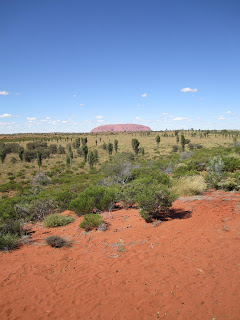
That is until The Rock comes into focus like a giant mutant hump on the landscape. The initial reaction is almost comedic: it is both instantly identifiable yet incredibly alien. The only thing to do is gawp at it, which has been the standard response of tourists for well over 50 years, since Northern Territory aviator Edward ‘EJ’ Connellan learnt quicker than most about the financial implications of dropping people into the country’s red centre. When Connellan started chartered flights to Uluru, his business advisors were adamant, asking “Who would ever want to visit that?”
From 1959, Connellan ran Qantas ‘Butterflies’ and Douglas DC3s from an airstrip directly beside the rock. Archive images show aircraft narrowly avoiding the monolith as they come into land. In 1962, tourist numbers reached 5,500. Now, the Uluru-Kata Tjuta National Park gets around 400,000 visitors a year. Wisely, a new airport was opened in 1984 outside the recognised National Park boundaries, some nine miles north of the Uluru site. This is the beige brick, steel pole and corrugated iron structure that you still arrive at today, seemingly modelled on a British leisure centre from the 1980s. It is still called Ayer’s Rock Airport, which is confusing, considering 26 years have passed since the land was handed back to the native Anangu traditional owners. Staring at a departure screen with the technical capabilities of Ceefax, Sydney suddenly feels thousands of miles away - both literally and metaphysically. Elemental things like time and space seem to serve very little purpose here.
In a trait so adorably Australian, the inherent dangers of the outback are everywhere. “Be prepared for dingoes and wild dogs,” says one sign, slightly gloating, I feel, and featuring this fabulously contrary advice: “If threatened by a dingo – STAY CALM!” Step outside, and within seconds a swarm of flies assemble into a makeshift beard to buzz around your face. Tourists, blurry eyed from a long haul flight and starting their outback journeys in the desert, may be averse to assume that they had not only landed on Mars, but also travelled back in time and been turned into defenceless prey for marauding beasts and insects. And that’s before they've even seen the resort.
The Ayer’s Rock Resort, located in the manufactured community of Yulara, is a purpose built holiday park run by the cast of Adventureland – mostly gap year, rosy cheeked sorts with time to burn and money to save. The resort currently employs 800 people. This number jumps to 2000 in peak season: chefs, janitors, Japanese interpreters, masseuses, bus drivers, newsagents, doctors, police, all employed to assist you in your gawping.
I am fascinated as to why anyone would purposely choose to stay here in complete isolation for longer than is truly necessary. The nearest town, Alice Springs, is 266 miles away. Our waiter Andy has been here for a year and possesses the resigned weariness of a man unsure as to whether he should spend his time polishing the cutlery or stabbing the implements into his knees. “I quit today,” he tells us. “I’m over it.” I’m told by one of the tour guides the average length of stay for employees is three months. We’re here for three days, and I would think that should be more than adequate.
Bill Bryson has a theory about this, that the rock possesses such a captivating, arresting, hypnotic quality that once you’ve seen it, it is hard to pull yourself away. “You realise that you could spend quite a lot of time – possibly a worryingly large amount of time; possibly a sell-your-house-and-move-here-to-live-in-a-tent amount of time – just looking at the rock, gazing at it from many angles, never tiring of it.” We talked to people on their third, fourth or fifth visits. Our tour guide, the indomitable Cheryl, is one week into a year long stint, travelling out there at 5am most mornings to catch the sun rise over the rock. We follow her out there one morning, and I can see why she does it.
Once you’ve paid the $25 entry fee to gain access to the park, it takes a good 20 minutes of driving until you can successfully bask under Uluru’s looming shadow. Now, considering that such a vast amount that has already been said on the subject, I want to make it clear from the outset that attempting to quantify and express those initial emotions is probably rather perfunctory, because even if you haven’t seen it, you can probably imagine just how amazed you will be when you finally do. Like Bryson says, “It’s not that Uluru is bigger than you had supposed or more perfectly formed or in any way different from the impression you had created in your mind, but the very opposite. It is exactly what you expected it to be. You know this rock.”
So here’s what you already know: it’s big. It’s huge, actually. It even looks big from the resort’s designated look out points, and they’re 20km away. To take a photo on ground level with the rock in full frame would almost certainly involve having to stand around 5km away from it. It is 1150 feet high, five and a half miles round. The base walk takes three and a half hours. Yes. It’s big.
It is also the same colour as the ground surrounding it due to the iron in the sandstone, which creates a rusted cover of redness. A very gradual erosive process is marking Uluru with dripping, clay-like contours and indentations on the surface, as if the whole thing is melting in slow motion. The rock has hills, and large crevices, caves, imprints and bizarre cavities. It has a front and a back. Every view from the ground level is unique; it never appears the same way twice. To dismiss it simply as a rock does Uluru a great disservice: it has personality.
This might explain Aboriginal dreamtime stories attributing the rock’s creation to giant snakes and lizards. The spiritual significance that the Anangu place on the rock is still very prominent: it is prohibited to photograph certain parts deemed sacred for ceremonial purposes, and despite signs imploring people not to, hoards of people still attempt to climb it.
Of course, it would be quite simple to stop people from doing this. You would think that the sheer exertion involved would be discouraging enough. Small sections of guide rope and a slight dirt track have been planted into the rock for assistance, but it’s a small gesture. There have so far been 38 deaths from people attempting to climb it – eight from falling off. But Cheryl thinks the figure could be in the hundreds. “People get back to their hotel rooms and don’t come out,” she says.
Quite recently, a family had to be rescued from the top with second degree burns when the searing heat caused their Crocs footwear to melt. Considering the temperate out here can reach 45°C (with the lowest evening temperatures recorded at -4°C), it is little wonder that Uluru is often closed to climbers. The Anangu have a word for people who climb the rock: minga. Ants.
Cheryl offers a more geological explanation as to how a giant rock might end up in the middle of such a vast, expansive and relatively flat nothingness. Uluru is in fact only the tip of a much larger underground sandstone mountain which descends 6km (around 3.7 miles) into the earth. To even comprehend this, you need to imagine a time of around 500 million years ago when huge fragmented clumps of sandstone were being rapidly transported from newly formed mountain ranges via fierce flowing rivers and dumped into oceans which have long since vanished. The ground around Uluru is still diminishing, unearthing more of the slowly eroding rock in the process. “Come back in 20 million years time and Uluru will be about two kilometres tall.” And Andy will probably still be working there.
In contrast, consider Kata Tjuta, which is actually 200 metres taller than Uluru and much bigger with a circumference of 24km (nearly 15 miles). Visually, it is much more staggering than it's iconic neighbour. Made up of 36 ‘domes’, it is located 16 miles from Uluru, and famously referred to as The Olgas. This is down to a somewhat elaborate display of brownnosing from intrepid Bristol born explorer Ernest Giles, who saw the protruding, phallic-like anomalies from a look out point at King’s Canyon and, for some reason, immediately thought of naming the tallest peak Mount Mueller, after the German born explorer Baron von Mueller, who happened to be funding his expedition. Mueller, instead, named it after Grand Duchess Olga Nikolaevna of Russia as a way of returning the complement for being made a baron. It is highly likely that Giles spotted Uluru at the same time, although all credit seems to go William Gosse, who gave it the name Ayer’s Rock in 1873 in recognition of South Australian Premier Sir Henry Ayers.
At Kata Tjuta, Cheryl leads us directly into a giant gorge amongst the domes, where vegetation thrives at even the highest, driest points. Here, we learn of the ancient techniques used to create paints for early Aboriginal rock art, and a brief lesson in botany: “Do you know why they call this a Dead Dog Tree?” she asks. “No bark.”
Of course, out in the desert of the Northern Territory, you’re probably more likely to come across a group of feral camels than you are wild dogs. While you ponder which one you would prefer to meet, rest assured that the federal government are doing something about this. In the sort of headline that quickly makes you realise how very far away you are from Leeds, Thursday’s NT News reveals an Egyptian businessman will construct an abattoir in South Australia with plans to process around 100,000 feral camels a year. Shipping camel meat to the Middle East will generate 250 jobs and $60 million a year.
I’ve now sat on the back of a camel twice. If the camel I encountered in Marrakech was a Ford Fiesta, then ‘Murphy’ in the Northern Territory is a Holden Commodore: a giant, snorting, 6 cylinder beast. Camels are so endearingly awkward in appearance that I’m not sure I like the thought of seeing one of them on my dinner plate. They’ve proliferated in the outback since their arrival from the Canary Islands in 1840, where they were used to help carry cargo during the building of cross-country telegraph lines. Their Afghan pilots didn’t have the heart to kill them when the work was done, so instead they let them go. Not being native to Australia and free of any serious diseases, the camel population is now increasing by some 90,000 a year. We even spot a group of them coming back from Kata Tjuta, and the desert’s a big place. The ominous array of footprints strewn across the red sand proves just how you're never quite alone when staying in the middle of nowhere.
Our final night is spent at a boisterous alfresco buffet as the sun sets over Uluru – its bright red hue altering in the twilight to a shadowy brown, before being silhouetted by the silver moon. Scott is our astronomer for the evening, pinpointing a blanket of crystal clear constellations from the Southern Cross to the rings on Saturn. I doubt there are many better places on the planet for someone like Scott to live, given the desert’s nightly palette. He has a degree in astrophysics, a masters in psychology and is about to start studying for a doctorate. His colleague Brett, however, has merely downloaded the Stargazer app for his iPhone. “You’ve wasted your time, mate,” Brett says. Scott chooses to ignore this.
Scott’s decision to up sticks and hit the desert links in with Bryson’s theory of obsession, and we find evidence of this everywhere. I talk with Heather Duff, the ‘artist in residence’ at the Ayer’s Rock Resort who travels up from Melbourne for three months every year to sell her bright Uluru landscapes. For her, the rock is a constant source of inspiration. I can only agree: the hardest part about leaving Uluru is actually forcing yourself to stop looking at it.
Honestly. Just go there.
Virgin Blue don’t fly direct to Ayer’s Rock Airport from Brisbane, so your flight south to Sydney takes one hour and ten minutes, followed by a journey northwest of three hours and thirty minutes: a combined travel time of four hours forty minutes. Leaving from London Heathrow, you could travel to Cairo in roughly the same time. Looking down over endless tracts of land - seemingly uninhabited, unperturbed and increasingly unremarkable - the sheer scope of the ground below takes on a breathless uniformity. Although we were only stopping halfway across the country, this is a scene that goes on. And on. And on.
That is until The Rock comes into focus like a giant mutant hump on the landscape. The initial reaction is almost comedic: it is both instantly identifiable yet incredibly alien. The only thing to do is gawp at it, which has been the standard response of tourists for well over 50 years, since Northern Territory aviator Edward ‘EJ’ Connellan learnt quicker than most about the financial implications of dropping people into the country’s red centre. When Connellan started chartered flights to Uluru, his business advisors were adamant, asking “Who would ever want to visit that?”
From 1959, Connellan ran Qantas ‘Butterflies’ and Douglas DC3s from an airstrip directly beside the rock. Archive images show aircraft narrowly avoiding the monolith as they come into land. In 1962, tourist numbers reached 5,500. Now, the Uluru-Kata Tjuta National Park gets around 400,000 visitors a year. Wisely, a new airport was opened in 1984 outside the recognised National Park boundaries, some nine miles north of the Uluru site. This is the beige brick, steel pole and corrugated iron structure that you still arrive at today, seemingly modelled on a British leisure centre from the 1980s. It is still called Ayer’s Rock Airport, which is confusing, considering 26 years have passed since the land was handed back to the native Anangu traditional owners. Staring at a departure screen with the technical capabilities of Ceefax, Sydney suddenly feels thousands of miles away - both literally and metaphysically. Elemental things like time and space seem to serve very little purpose here.
In a trait so adorably Australian, the inherent dangers of the outback are everywhere. “Be prepared for dingoes and wild dogs,” says one sign, slightly gloating, I feel, and featuring this fabulously contrary advice: “If threatened by a dingo – STAY CALM!” Step outside, and within seconds a swarm of flies assemble into a makeshift beard to buzz around your face. Tourists, blurry eyed from a long haul flight and starting their outback journeys in the desert, may be averse to assume that they had not only landed on Mars, but also travelled back in time and been turned into defenceless prey for marauding beasts and insects. And that’s before they've even seen the resort.
The Ayer’s Rock Resort, located in the manufactured community of Yulara, is a purpose built holiday park run by the cast of Adventureland – mostly gap year, rosy cheeked sorts with time to burn and money to save. The resort currently employs 800 people. This number jumps to 2000 in peak season: chefs, janitors, Japanese interpreters, masseuses, bus drivers, newsagents, doctors, police, all employed to assist you in your gawping.
I am fascinated as to why anyone would purposely choose to stay here in complete isolation for longer than is truly necessary. The nearest town, Alice Springs, is 266 miles away. Our waiter Andy has been here for a year and possesses the resigned weariness of a man unsure as to whether he should spend his time polishing the cutlery or stabbing the implements into his knees. “I quit today,” he tells us. “I’m over it.” I’m told by one of the tour guides the average length of stay for employees is three months. We’re here for three days, and I would think that should be more than adequate.
Bill Bryson has a theory about this, that the rock possesses such a captivating, arresting, hypnotic quality that once you’ve seen it, it is hard to pull yourself away. “You realise that you could spend quite a lot of time – possibly a worryingly large amount of time; possibly a sell-your-house-and-move-here-to-live-in-a-tent amount of time – just looking at the rock, gazing at it from many angles, never tiring of it.” We talked to people on their third, fourth or fifth visits. Our tour guide, the indomitable Cheryl, is one week into a year long stint, travelling out there at 5am most mornings to catch the sun rise over the rock. We follow her out there one morning, and I can see why she does it.
Once you’ve paid the $25 entry fee to gain access to the park, it takes a good 20 minutes of driving until you can successfully bask under Uluru’s looming shadow. Now, considering that such a vast amount that has already been said on the subject, I want to make it clear from the outset that attempting to quantify and express those initial emotions is probably rather perfunctory, because even if you haven’t seen it, you can probably imagine just how amazed you will be when you finally do. Like Bryson says, “It’s not that Uluru is bigger than you had supposed or more perfectly formed or in any way different from the impression you had created in your mind, but the very opposite. It is exactly what you expected it to be. You know this rock.”
So here’s what you already know: it’s big. It’s huge, actually. It even looks big from the resort’s designated look out points, and they’re 20km away. To take a photo on ground level with the rock in full frame would almost certainly involve having to stand around 5km away from it. It is 1150 feet high, five and a half miles round. The base walk takes three and a half hours. Yes. It’s big.
It is also the same colour as the ground surrounding it due to the iron in the sandstone, which creates a rusted cover of redness. A very gradual erosive process is marking Uluru with dripping, clay-like contours and indentations on the surface, as if the whole thing is melting in slow motion. The rock has hills, and large crevices, caves, imprints and bizarre cavities. It has a front and a back. Every view from the ground level is unique; it never appears the same way twice. To dismiss it simply as a rock does Uluru a great disservice: it has personality.
This might explain Aboriginal dreamtime stories attributing the rock’s creation to giant snakes and lizards. The spiritual significance that the Anangu place on the rock is still very prominent: it is prohibited to photograph certain parts deemed sacred for ceremonial purposes, and despite signs imploring people not to, hoards of people still attempt to climb it.
Of course, it would be quite simple to stop people from doing this. You would think that the sheer exertion involved would be discouraging enough. Small sections of guide rope and a slight dirt track have been planted into the rock for assistance, but it’s a small gesture. There have so far been 38 deaths from people attempting to climb it – eight from falling off. But Cheryl thinks the figure could be in the hundreds. “People get back to their hotel rooms and don’t come out,” she says.
Quite recently, a family had to be rescued from the top with second degree burns when the searing heat caused their Crocs footwear to melt. Considering the temperate out here can reach 45°C (with the lowest evening temperatures recorded at -4°C), it is little wonder that Uluru is often closed to climbers. The Anangu have a word for people who climb the rock: minga. Ants.
Cheryl offers a more geological explanation as to how a giant rock might end up in the middle of such a vast, expansive and relatively flat nothingness. Uluru is in fact only the tip of a much larger underground sandstone mountain which descends 6km (around 3.7 miles) into the earth. To even comprehend this, you need to imagine a time of around 500 million years ago when huge fragmented clumps of sandstone were being rapidly transported from newly formed mountain ranges via fierce flowing rivers and dumped into oceans which have long since vanished. The ground around Uluru is still diminishing, unearthing more of the slowly eroding rock in the process. “Come back in 20 million years time and Uluru will be about two kilometres tall.” And Andy will probably still be working there.
In contrast, consider Kata Tjuta, which is actually 200 metres taller than Uluru and much bigger with a circumference of 24km (nearly 15 miles). Visually, it is much more staggering than it's iconic neighbour. Made up of 36 ‘domes’, it is located 16 miles from Uluru, and famously referred to as The Olgas. This is down to a somewhat elaborate display of brownnosing from intrepid Bristol born explorer Ernest Giles, who saw the protruding, phallic-like anomalies from a look out point at King’s Canyon and, for some reason, immediately thought of naming the tallest peak Mount Mueller, after the German born explorer Baron von Mueller, who happened to be funding his expedition. Mueller, instead, named it after Grand Duchess Olga Nikolaevna of Russia as a way of returning the complement for being made a baron. It is highly likely that Giles spotted Uluru at the same time, although all credit seems to go William Gosse, who gave it the name Ayer’s Rock in 1873 in recognition of South Australian Premier Sir Henry Ayers.
At Kata Tjuta, Cheryl leads us directly into a giant gorge amongst the domes, where vegetation thrives at even the highest, driest points. Here, we learn of the ancient techniques used to create paints for early Aboriginal rock art, and a brief lesson in botany: “Do you know why they call this a Dead Dog Tree?” she asks. “No bark.”
Of course, out in the desert of the Northern Territory, you’re probably more likely to come across a group of feral camels than you are wild dogs. While you ponder which one you would prefer to meet, rest assured that the federal government are doing something about this. In the sort of headline that quickly makes you realise how very far away you are from Leeds, Thursday’s NT News reveals an Egyptian businessman will construct an abattoir in South Australia with plans to process around 100,000 feral camels a year. Shipping camel meat to the Middle East will generate 250 jobs and $60 million a year.
I’ve now sat on the back of a camel twice. If the camel I encountered in Marrakech was a Ford Fiesta, then ‘Murphy’ in the Northern Territory is a Holden Commodore: a giant, snorting, 6 cylinder beast. Camels are so endearingly awkward in appearance that I’m not sure I like the thought of seeing one of them on my dinner plate. They’ve proliferated in the outback since their arrival from the Canary Islands in 1840, where they were used to help carry cargo during the building of cross-country telegraph lines. Their Afghan pilots didn’t have the heart to kill them when the work was done, so instead they let them go. Not being native to Australia and free of any serious diseases, the camel population is now increasing by some 90,000 a year. We even spot a group of them coming back from Kata Tjuta, and the desert’s a big place. The ominous array of footprints strewn across the red sand proves just how you're never quite alone when staying in the middle of nowhere.
Our final night is spent at a boisterous alfresco buffet as the sun sets over Uluru – its bright red hue altering in the twilight to a shadowy brown, before being silhouetted by the silver moon. Scott is our astronomer for the evening, pinpointing a blanket of crystal clear constellations from the Southern Cross to the rings on Saturn. I doubt there are many better places on the planet for someone like Scott to live, given the desert’s nightly palette. He has a degree in astrophysics, a masters in psychology and is about to start studying for a doctorate. His colleague Brett, however, has merely downloaded the Stargazer app for his iPhone. “You’ve wasted your time, mate,” Brett says. Scott chooses to ignore this.
Scott’s decision to up sticks and hit the desert links in with Bryson’s theory of obsession, and we find evidence of this everywhere. I talk with Heather Duff, the ‘artist in residence’ at the Ayer’s Rock Resort who travels up from Melbourne for three months every year to sell her bright Uluru landscapes. For her, the rock is a constant source of inspiration. I can only agree: the hardest part about leaving Uluru is actually forcing yourself to stop looking at it.
Honestly. Just go there.
Labels:
camels,
Edward 'EJ' Connellan,
Kata Tjuta,
Northern Territory,
Sydney,
Uluru
Subscribe to:
Posts (Atom)