Sunday, 6 March 2011

Green Streets

South Australian Liberal senator Mary Jo Fisher lost her flippin’ marbles in parliament this week with a quite incredible rebuff to Gillard’s carbon tax proposals, drawing barmy metaphorical collusions between coalition policy and the Timewarp from Rocky Horror Picture Show. But this was a tame protest when you discover the sort of phone calls Independent MP Tony Windsor has been getting this week, one of which concluded with the words, “I hope you die, you bastard”.

Windsor copped some flack for taking the threat straight to Channel 7 instead of the police - which is more like the sort of thing a normal person might do - and then broadcast the message on the ABC, comparing the vitriolic response to the anger which sparked the shooting of American congresswoman Gabrielle Giffords. That might sound a bit rich, but then Opposition MP Sophie Mirabella trounced Windsor by comparing Her Maj’ Ms Gillard to Libyan leader Moamar Gaddafi. It was more in reference to his deluded ‘my people will die for me’ comments, rather than all the killing and stuff.

Even The Terminator stepped in at that point. “I think that's a pretty colourful way of describing the Prime Minister, and it’s not language I would normally use myself,” said Tony "shit happens" Abbott. Now we have a media war with lefty organisations pointing fingers at talk radio shock jocks for fuelling the fire. Like 2GB’s Alan Jones, who had an on-air argument with Her Maj (pictured left with Greens leader Bob Brown) after she arrived ten minutes late for his breakfast show interview. “Surely courtesy has to be part of the way in which the public are treated?” he tuts, probably tapping at his wrist watch. “Alan, I believe I am a very courteous person. I’m also very busy…” The tiff continues, descending - quite inevitably - into name calling. Children, please.

Extending political similes further, this is far from Her Maj’s Poll Tax moment. Australia is well placed to cement its standing as a world leader in combating climate change, what with Green Party influence amongst a sympathetic coalition that recognises the potential of leading by example. But no one said changing the world would be easy.


There’s an old adage that tells of how the rich and powerful lose their connection to ‘the people’ when they forget the price of milk. Aussie diary farmers do not share such dilemmas: just the sight of the price tag alone is enough to cry over, spilt or otherwise. A price war has erupted in which the Big Two (that’s Coles and Woolworths, who share a supermarket monopoly with an equally repugnant and exploitative business sense) are both selling own-brand milk for $1 a litre. That is quite clearly outrageous, and completely cripples the farmers they claim to support.

Multi-million dollar conglomerates can afford to do this kind of swindling financially, but not morally. We have fresh organic produce delivered to our door and we try to get all of our meat from the local butcher, and I’m sure many others do the same. Australia doesn’t need to import produce in the same way Britain does, and the bush farming community is highly valued. Insults like this one will be hard for shoppers to wear. As Julian Lee writes in the Sydney Morning Herald: “We would like to see some truth in advertising, so the next time I see a supermarket ad with a farmer in it, I expect him to be in a headlock rather than an embrace.”


The campaign for daylight savings time in Queensland has stepped up a gear, judging by this graffiti I discovered on the back of a bus seat. Granted, the 345 to Aspley isn’t particularly a front runner when considering potential hotbeds of political unrest. State Premier Anna Bligh should have no reason to be losing sleep just yet. Brisbane residents want daylight savings so that they can enjoy the sunshine for an hour longer, which in turn puts north Queensland farmers out of whack as they are quite accustomed to the idea of starting and finishing earlier. Queenslanders are often faced with the prospect of a referendum regarding daylight savings - the topic is likely to be re-packaged for Queensland’s 2012 elections. Small scale campaigning may already be under way. After all, the writing's on the wall. Or, the bus seat, rather.


AU Tube: Understanding Australian TV
Laid’ (ABC1)

With minor exceptions, finding a good Australian sitcom amongst the turgid quagmire of American guff is a bit like discovering Solomon’s treasure. Not surprisingly, when I told an Aussie friend how good ‘Laid’ was, her reply was self-evident: “really?”, said with complete incredulity.

‘Laid’ is a black comedy in the Bridget Jones mould which is both intelligent and silly, awkward and charming, detailing the frumpy sexploits of Roo McVie who finds herself inexplicably cursed on the path to true love when her former sexual partners start dying in increasingly bizarre circumstances. In last week’s episode, two of them pop their clogs choking on hors d’oeuvres at an emergency meeting of Roo’s ex-boyfriends. Roo’s desperation in dealing with the revealing sinful extremities of her past is funny enough - she visits the hot-tub of a self-taught ocker shaman in attempts to dispel the curse - but then she must also face future implications for any potential new suitors.

Roo is played by Alison Bell with a endearing lightness of touch; her roomie Celia Pacquola is hilarious. The show’s writers Kirsty Fisher and Marieke Hardy cite ‘Gavin & Stacey’ and British comedies as their main influence, and there’s no denying a certain post-Gervais overtone to the show's dry humour. I first fell in love with Hardy as a regular guest critic on Jennifer Byrne’s ‘First Tuesday Book Club’ - with this show, she seems to have spearheaded a crucial movement for female comedic talent offering a better and more relevant alternative to the country’s dated, male-dominated gag blowers that you find on shows like ‘Good News Week’ and ‘Hey, Hey, It’s Saturday’, many of which are about as funny as heart surgery.

In a gesture of bipartisanship, I should rightfully add ‘Ben Elton: Live from Planet Earth’ to that list, which I intended to watch for this week’s AU Tube but couldn’t quite muster enough energy to sit through a whole episode. The tortuous, creaking sound of Elton’s career flat-lining was just too overbearing: the jokes are so bad not even the studio audience quite know what to do with themselves. The discomfort is palpable. I’m guessing the show hasn’t had a British airing, but it takes a particularly brazen act of disregard from Elton to presume that such a prehistoric show could ever carry weight for an Australian audience, especially when a program like ‘Laid’ proves so convincingly just how much native palettes have matured.

Saturday, 19 February 2011

The A Team

Those accustomed to the dilapidated nature of English football grounds will be suitably awed by Brisbane’s Suncorp Stadium. Maybe all football stadiums are like this now - plasma screens, airconditioning and inbuilt food stalls selling nachos. The beauty of supporting a team like Swindon Town is that it’s possible to believe that nothing has really changed much for the past hundred years.

Given the sunken nature of the Suncorp pitch, the ground resembled a leaky goldfish bowl when the Big Floods hit in January, retaining the waters which climbed into the first ten rows and no doubt seeped into the boys changing rooms. The first game back on the freshly drained and sandy turf was last week’s football game between Brisbane Roar and Gold Coast United - the last game of the A-League - and judging by the 20,000 strong crowd, with their faithful flags, Magnum Ice and $6 beers, you would be right in thinking that the whole ghastly catastrophe of the previous month had all just been some terribly messy dream.

‘Roar’, of course, sounds more like a breakfast cereal than a football team. They play in a sort of fluorescent orange; a dribbling vision of monosodium glutamate. Gold Coast United have a more boring name and possess an unfortunate affliction of having to play in the same colours as the Brazilian national team. But you won’t confuse the two: Roar win with a convincing 4-0 victory (the first of which is scored after three minutes), securing their place as A-League champions and not without a certain flair. Roar winger Henrique is particularly sprightly; he may be more Julian Joachim than Michael Owen, but he’s still the sort of ferreting annoyance to cause any defence an awful bother, while the fourth goal was a training ground tap in thanks to a napping Gold Coast who were already half way down the M1 by that point.


All of which concludes a triumphant season for the local Brisbane team, who finish top of the league and with a 25 game unbeaten run. That’s pretty good, considering they finished second from bottom last season. Brisbane Roar now go through into a ridiculous play-off situation to decide the overall A-League champions, which is something synonymous with American sports and thankfully unheard of in Europe. By this token, and despite an incredible season, a team like Central Coast Mariners (who finished second) could still possibly go on to nab the final trophy. As someone brought up to believe that points mean prizes, I find this a baffling concept. Regardless, Brisbane Roar will play Central Coast Mariners tonight, the first of two legs, while Gold Coast United play Melbourne Victory tomorrow.

I should make some horribly glib remark regarding the quality of the football being particularly accurate for someone already accustomed to watching Swindon Town, but then the English often forget just how lucky they are to have the best football league in the world. Not that the fans have any chance of watching it, of course. Thanks to a special discount designed to get bums on seats, we acquire six tickets for the game for only $60. That’s ten bucks each - around six English pounds. You’d be lucky to buy braising steak from Woolworths for that price.

But the A-League and football in general has a larger following here than you might think, particularly over the last few years, even enough to warrant a faction of noisy, aggressive fandom. We’re not quite talking the likes of Leeds’ Service Crew here - the ‘Den’ and the ‘Orange Army’ have a fair bit of disgraceful catching up to do in that regard - but their small legion of psychotics already have a small set list and an enthusiastic drummer, and that goes a long way. Bizarrely, they may even have a political agenda: a banner during the second half reads ‘Justice for the NT’ to the bemusement even of my Australian company. Perhaps a statement against social inequality in the Northern Territory? I might be wrong, but if I'm not, then I think Millwall fans could learn a lot from these hoons.


When Australians discuss the Big Things, they’re not always referring to issues like aboriginal land rights, or excessively right wing immigration policies, or Julia Gillard’s dress sense. They might be, of course, but more than likely they will be referring to Things of a much grander scale. Perhaps as an antidote to the boredom of long distance driving, or maybe as a result of all that vast, empty space causing eccentric country settlers to completely lose their grasp on normality, but a wonderfully pointless series of giant objects can be found up and down the land - hidden, mostly, but completely wonderful in their pointlessness.

Green-bashing nay-sayers may bemoan the elegant spinning wind turbines that charge across parts of the British countryside, but at least they serve a purpose. The same can be said for electricity pylons, telephone masts, satellite dishes. Ugly to some, yes, but indispensable to the way we live. Some Big Things are there just to be there: the Eiffel Tower, the Angel of the North, the Washington Monument may present nothing more than a minor threat to low-flying aircraft, yet their awesome artistic stretch and sense of identity never fails to inspire. But if you head north along the Pacific Highway out of Brisbane and into the Sunshine Coast town of Nambour, Queensland, you’ll find the type of monolith that quite defies all you thought you knew about the Big Things in life.

Because this is where you’ll find The Big Pineapple. Built in 1971, I’m not certain of its specific measurements, but I’m sitting next to it in the picture opposite and, as you can see, it’s pretty damn big. Pretty big for a piece of fruit, anyway. Many of Australia’s Big Things are merely promotional gimmicks - the awesome Big Prawn in Ballina, the Big Banana in Coff’s Harbour, a Big Hotdog in Radcliffe - but this grossly oversized fibre-glass construction sits outside a macadamia nut farm, which just doesn’t make any sense at all. Research reveals that there is also a Big Macadamia on site, but we arrive on a Sunday and we can’t get close enough to confirm this.

A sign on the gate reveals that The Big Pineapple is “closed for future changes”. While you ponder what sort of changes could possibly be required, I should add that it is possible for visitors to climb inside the pineapple and, peering through it’s tropical plumage, observe the nut farm, petting zoo and its surrounding environs like some kind of pioneering fruit Tsar. Once upon a time, there was another giant pineapple further up the road in Gympie - “the original,” apparently, presumably said with some menace - but this was quite upsettingly pulled down in 2008. You seriously have to question the merits of a place with such a spoil sport mentality, especially one with a name like Gympie.

But a similar fate that may befall this Big Pineapple, as the site is now under new ownership following a $533,700 bill from the Australian Taxation Office forcing the previous owners into receivership. It’s future is uncertain, which evidently explains why the place is practically off limits, bolted shut with desolate car parks (yes, there are two car parks) humming to the tune of bored boy racers performing handbrake turns across a stretch of empty bitumen. That’s right: the Big Pineapple might get the squash.

You probably won’t believe me, but at it’s peak, Their Royal Highnesses Charles and Diana popped in to The Big Pineapple to have a ride on one of their toy trains during a recce of the plantation in 1982. They were growing pineapples back then, too, presumably before an insurmountable expenses bill caused the humble Queensland farmer to diversify and flounder, struggling against the monetary force of their own fruit salad. Blimey, who would have thought that giant fruit could be so depressing?


The week long, biannual Lifeline Brisbane Bookfest - which takes place in a convention centre roughly the same size as Moscow - is much more than a place where fads go to die, although if pictures paint a thousand words, then this photo would presumably include much better words than those of Dan Brown's in The Da Vinci Code, which seems to have been so eagerly abandoned that the organisers had to give the book its very own section. There were similar drop off points for Pamela Stephenson’s Billy and Halliwell’s Film Guides from the 1980s. The target for Lifeline was to raise $1 million in funds for Flood Relief, and they had successfully made well over half their total just on the opening weekend.

The Bookfest is an epic, endless search for those with the time and the inclination, and I just adore second hand book sales. I love the nosey, sticky beak nature of it almost as much as the hunt for that rare find: from a books’ ghostly inscription (“For Mum, Merry Christmas, 1977”) to the odd surprise of finding some misplaced family relic, like the photograph of someone’s child in the goat enclosure of a petting zoo that I found in a copy of Bill Wannan’s Folklore of the Australian Pub.

And how cheap! In a week that the Borders book store goes into administration, there can surely be only small condolences for a store which charges such astronomical prices for products that could be obtained at a fraction of the cost on the internet. The death of the corporate chain will only make niche independent book stores more relevant. Just remember to really stock up next time.

Thursday, 3 February 2011

Kiss My Yasi

On Wednesday, News.com.au ran this rather terrifying superimposed graphic of what Cyclone Yasi would look like if placed over the continents of the world. With a diameter of 250 miles (400km), the storm quite comfortably swallows the whole of England, the state of Louisiana, and half of New Zealand.

Furious gusts of up to 285kph - flattening the towns of Tully, Cardwell and Innisfail - somehow managed to avoid killing anyone, but certainly made an aggressive attempt. Quickly identified as a Category 5 cyclone, Yasi was more intense than both 2006’s Larry and 1974’s Tracy, the latter of which convincingly destroyed the town of Cairns and 71 of its inhabitants over the Christmas period. And that was a Category 4 cyclone. Category 5 is the highest you can get: “extremely dangerous with widespread destruction,” according to the Australian Bureau of Meteorology website, which over the past month has become the home page for nearly all Queenslanders.

Channel 7 cancelled their scheduling for another hysterical non-stop talk fest, whipping the winds into a further frenzy and giving Queensland Premier Anna Bligh an ample platform to reclaim her soap box. She earned it well and truly with her compassion and sentimentality during the January floods, where she actually broke down in tears during a press conference, inspired by the selfless nature and courage of those affected by the carnage. This is now referred to as The Queensland Spirit. You can even buy your own slice of The Queensland Spirit on three CDs, with all proceeds going to the Flood Relief Appeal.

Bligh was back like a rampant Rambo commanding the TV coverage with her well honed, Churchill esque rhetoric, as if she might be preparing to head north and physically wrestle with the cyclone from the state’s shoreline. This was no storm in a teacup, as Bligh issued her final warning: “You have to take this window of opportunity now. Do not bother to pack bags, just grab each other and get to an area of safety. People are irreplaceable. We shall fight this on the beaches. We will never surrender.” Yes, OK, I may have embellished that a little, but with such positive public support, surely Bligh couldn’t possibly fail to retain her premiership when it comes to next year’s state elections. Heck, you would believe she was practically running the country right now, making sour-faced Labour compadre Ms Gillard look like some form of robotic intern.

If such a thing exists as The Queensland Spirit, then surely it's very embodiment can be explained by a simple sign in a Cairns cafĂ© which reads, ‘Kiss my Yasi’. So it might be an idiosyncratic mixture of both tenderness and bravado, of laughing in the face of adversity, and a sort of underdog mentality: like the Bulldog Spirit, but a bulldog in thongs and a singlet. It’s actually a media invention, mostly, purported by the likes of Channel 7, who threw caution to the wind and their sanity out the window with the sort of excruciating news coverage that could actually warrant the end of the earth.

Still buoyed by the horrifically captivating scenes of Brisbane’s monumental floods, the network went into full 24-hour disaster porn mode, reporting on news that hadn’t even happened and, then when it did, a complete loss of power guaranteed that the majority of it would be completely incomprehensible. At one point, nonsensical two-ways were broadcast via Skype and a reporter’s iPhone. With journalists clearly exempt from evacuation notices, the most anyone could possibly deduce from this garbled interference was that actually, yes, it was really very windy outside. “But just how windy is it?” and so on and so on and so on.

But it’s hard to take such excessive scaremongering seriously when members of the public are continuing with their daily routines in the background. Category 5 cyclones may be unique in their severity, but storms are not unfamiliar to Australia. We are now entering a tropical cyclone season. There is actually a specified season for this, and the Bureau of Meteorology are predicting more cyclones to follow.

Being English and completely unaware of what to do in this situation, you can be sure that Toxic Math is taking precautions. I’m told the safest place is the bath tub. But without one, I’ll just be standing in the shower until this whole thing blows over.


One of the reoccurring debates on Australia Day is the design of the flag - it's an annual patriotic sticking point, like having the Queen on a postage stamp. Modern consensus seems to suggest that the Southern Cross bit is quite alright, but what really gnaws on the public conscious is that Union Flag in the top left. I was a bit surprised at the extent of vehemence considering just how many Australians proudly fly the flag even when they’re not annually obliged to do so. I can honestly say that I have never felt the need to paint a flag on my face. Any flag, for that matter. Yet Australia Day passed in a sea of blue, red and white, seemingly proud of it’s symbolic gesture despite the design.

All of which links us back to the country’s colonial past and the significance of January 26 as the date when the first British fleets sailed into Sydney Cove in 1788 (and not when Captain Cook first landed in Australia, which actually happened in April some 18 years earlier). But what most Australians actually prefer to celebrate is the notion of not having to go into work, bolstered by a unified but jovial sense of celebrating their national identity. Which is why the day is traditionally spent around a barbecue, tucking into lamingtons, damper and assorted bush tucker, with the odd eccentric past time to boot: cockroach racing, for one, and even the odd thong-throwing competition. Sadly, I’m completely stumped to conjure up a British equivalent, other than eating fish and chips, at a bus stop, while it rains. On a Tuesday.

Australia Day is instead referred to as ‘Invasion Day’ by some, used as evidence of yet another aspect of marginalising the country’s indigenous population. Given that the oldest Aboriginal art in parts of South Australia are estimated to be around 40,000 years old, and that the indigenous population possessed the lay of the land for about another 20,000 years on top of that is food for thought especially to those who seem to regard Australia as a young country. I noted a greater sense of inclusion and compassion on the day in recognition of the country’s first Australians, but more can and should be done on all the other days. So perhaps a new flag is necessary, but one with a bit more yellow, red and black.

I will end on the results of this year’s Triple J Hottest 100, which is slowly announced over the course of Australia Day on the ABC’s flagship Gen Y radio station. And just what did those rebellious, pill-popping, know-all teen layabouts in their trendy sneakers vote for as the nation’s best record of the year? ‘Big Jet Plane’ by sleepy folk siblings Angus and Julia Stone. I know. Those crazy bastards.

Thursday, 20 January 2011

Four Seasons in One Day: Welcome to Melbourne (Part II)

In January 1990, there was a bit of an incident involving a limestone formation on the coastline of the Port Campbell National Park in the very south of Victoria. Called London Bridge - named after its rocky resemblance to the English landmark - an eroded section connecting the faraway point of the stack to the shoreline dramatically collapsed into the sea. This is pretty much academic to anyone with even a basic grasp of how the world is formed, but here’s the interesting bit: two people were on it at the time.

To come so close to death’s squelchy grasp and survive is one thing, but to pray witness to such a shape shifting event is quite another; the moment when an area of Victoria just disappeared into the ocean. Of course, land patterns aren’t permanent no matter where we draw the line, and more limestone will be chipped away and eroded to equally dramatic effect in the ensuing years, transforming cliffs into caves, caves into arcs, arcs into stacks, and stacks into the inevitable absorption of the sea. Nowadays, London Bridge is known as London Arc. Pretty soon, it will just be ‘London’. Then ‘Lon’. Then nothing.

Which makes the lauded Twelve Apostles even more dramatic, especially if coastal morphodynamics is your thing. These are a series of limestone stumps dotted along the Victoria coastline, although there seems to be some contention as to where the name comes from, because no matter how many times you count them, there is still clearly seven of them. There were eight, apparently, although one of them gave up somewhere in 2005.

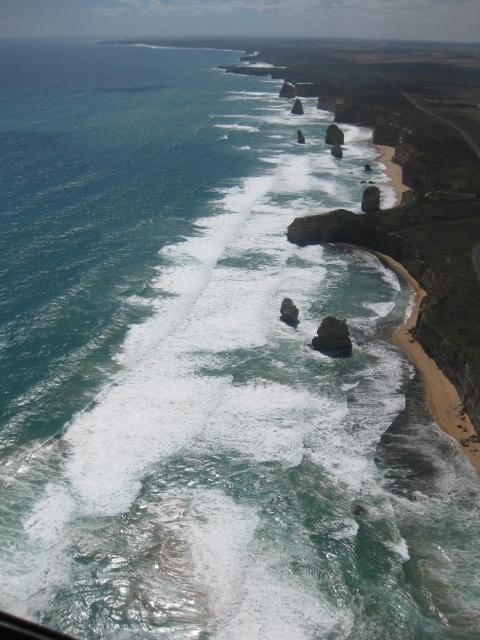
Nowadays, you can choose to pay a healthy sum to take a ten minute helicopter ride over the Twelve Apostles and see the diminishing attributes of Mother Nature in all her tempestuous, foamy glory. It’s worth doing, because you get views like the ones I have attached. We also check out the structures at ground level from the designated viewing plinth, but after a ride in the chopper, that’s basically the equivalent of starting a meal with your pudding.


Anyway, back to those stranded souls who found themselves, quite literally, on the precipice of an earth-shattering event. This is where I will introduce Matt, our tour guide, who makes no qualms regarding the volume of the music in his minibus. “The speakers are right at the back so I have to have it on pretty loud,” which is at least some form of an excuse. He sports a porkpie hat in the manner of a singer from a ska band: Buster Bloodvessel, without the cholesterol. It’s not the volume of the music that’s striking, but rather his choice of songs. Matt makes a habit of accompanying his storytelling with tactful musical referencing. Which explains why our descent from London Arc is accompanied by the apt sounds of Fontella Bass singing ‘Rescue Me’. (This is quite a fun game for anyone with time to spare on a shuttle bus: we decide that he could just as easily opted for ‘Bridge Over Troubled Water’, ‘Stuck in the Middle with You’ and, of course, ‘Help!’).

The dramatic beaches near Port Campbell are also infamous as the residual resting place of 19th century shipwrecks which still pot mark the treacherous landscape of Wreck Beach. The Victoria gold rush of the industrial age brought as many as 100 ships a day from Britain to Melbourne full of eager prospectors, and up to 200 ships would meet their end in these waters, trickily navigating the 80km channel between the Bass Strait islands and the limestone sea stacks. One sea weary captain at the time described navigating this passage as being like "threading a needle".

This is where you can still find the rusted anchor of the Marie Gabrielle, a French vessel which ran aground in 1869, and the British steamer Fiji which hit the rocks in 1891 killing its entire crew. “For the impoverished coastal farmers, any wreck was a tragedy, but it could also be like Christmas,” writes Tony Perrottet in The Weekend Australian. “The locals descended in droves to pillage the Fiji for its wood and cargo: liquor, European clothes, porcelain, toys, even a couple of grand pianos.” We do manage to get down and see Loch Ard Gorge, a violent swell of tortuous sea and shaggy rock which would prove fatalistic to a British ship leaving Gravesend in 1878 with its sight set on Melbourne. Only two would survive the famous Loch Ard crash out of the 54-strong crew, including a boy, Tom Pearce, who miraculously managed to land on the only patch of sand in the gorge.

Pearce heard the screams of another passenger, Eva Carmichael, clinging to a chicken coop. She was rescued, and Pearce somehow managed to scale the high cliffs to alert the villages of the disaster (there are some stairs there now, including a handrail). Despite calls from the press for the two to be engaged, Pearce returned to a life at sea where he later found himself the victim of two more shipwrecks before deciding that enough was, indeed, enough.

The reason you can’t just walk down to the fabled Shipwreck Coast is because it’s officially outside of the Great Ocean Road tourist trail. In fact, the cliff tops would prove so overbearing for even the road’s builders that they were forced to make an inland detour around Cape Otway just to avoid it. The Great Ocean Road, Australia’s most scenic route, is some 270km long (nearly 170 miles) and every inch of it was constructed by hand without the aide of explosives or machinery. The Memorial Arch in the town of Anglesea explains how the road was eventually completed in 1932 by some 3,000 soldiers returning from the First World War, a war in which Australia would suffer the highest casualty rate out of all the allied forces: somewhere around the 64% mark. Returning soldiers seeking employment in 1918 were put to work building the road and paid well for the trouble. Matt plays Sheryl Crow singing ‘Every Day is a Winding Road’ as the bus shimmies through a breathtaking, industrial masterpiece.

Matt does three driving tours a week and he’s been up since 5am this morning. “I’ve done this tour so many times I can do it in my sleep,” he says encouragingly, adding, “that’s why I wear the sunglasses.” He drives us through Geelong, which could have been the equivalent of what Melbourne is today if the city's bay was big enough to accommodate larger ships, and then onto Torquay, which is officially where the Great Ocean Road starts.

Australia’s Torquay has a proud heritage to rival that of England’s Torquay, which is now destined to forever be associated with Helen Chamberlain and ‘Faulty Towers’. Torquay is the surf capital of Australia, not only the home of the Quiksilver and Rip Curl brands, but also Bells Beach, which even I had heard of; probably something quite rare for someone with a complete aversion to swimming in the ocean. Quite coincidentally, I can pinpoint the blame for this to a holiday in Torquay, England; braving the bitterly cold, litter-strewn sea while dodging a spare jellyfish. In hindsight, it is unlikely that this was a jellyfish, and was probably a plastic bag of some kind, submerged amongst the dank swell, but still the fear remains.

Bells Beach is mentioned in the film Point Break, you see, which had Keanu Reeves and Patrick Swayze cast as quite believable surfies, and is now probably old enough to be deemed ironic. “I watched it again recently,” Matt says over his microphone, “I thought it was better in the 90s.” Matt’s derision doesn’t end there: the climax of the film sees the two central actors go to Bells Beach to tackle a once in a lifetime killer wave, dude, but the scene was actually filmed in Portland, Oregon. Bells is still the only certified surfing recreational site in the world, with rights in place to protect the area from damage to the environment. I’m guessing this must have been before that big car park was built, with space to accommodate a daily turnover of ogling tourists, which is certainly something to dwell on as we hit the road again and Matt blares out the greatest hits of The Beach Boys.

The Great Ocean Road is a thing of such sweeping, epic and romantic splendour that it rightly resides as one of Australia’s Top Things To See. It is a dramatic achievement as both a memorial for the country’s fallen soldiers and as a testament to the majestic landscape of which they would never return, sacrificed in the murder of Gallipoli and beyond. Through their commemorations, the road has opened a once remote expanse of coastline to celebration from people all over the world, and that is a splendid thing.

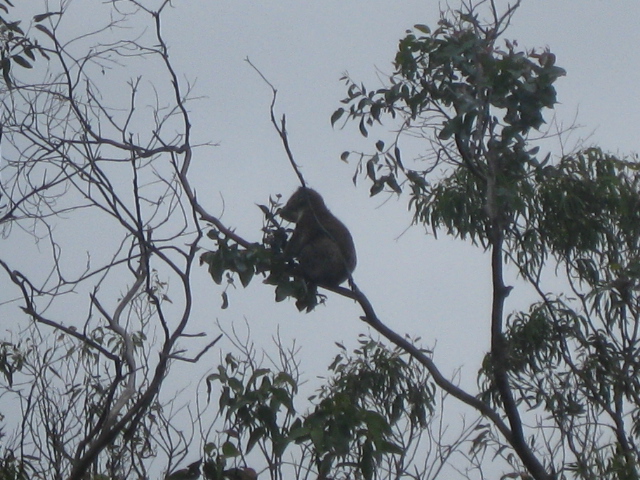
The iconic images of the Apostles may end the trail, but there is much wonder to explore along the way; from the beach town of Lorne, home of the Lorne Pier to Pub Swim (surely only in Australia could a sporting event end in a pub?), to the Kennett River Holiday Park where rosellas and koalas abound, and the Maits Rest Rainforest Walk where slender mountain ash trees stretch to their astronomical heights - the tallest recorded at just under 100 metres. Matt’s whistle-stop tour makes an orchestrated stab at catching a glimpse at all of this wonder in a single day, which is no mean feat, and we return to the hotel exhausted.

“Thank you Matt,” we offer, “and get some rest.”
“Can’t mate,” he says, “I’m up at 5am tomorrow to get to Phillip Island.”
Poor guy. He’s had a hard day’s night.

Tuesday, 11 January 2011

Four Seasons in One Day: Welcome to Melbourne (Part I)

From some of the worst flooding in Queensland’s history we fly south to Victoria and arrive during a Melbourne heat wave. It’s New Year’s Eve and a flashing sign on the Tullamarine Freeway reads ‘Fire Ban Today’ in bright orange letters - but how do you even begin to police something like that, I ask the taxi driver, a Czech migrant who has been living in Melbourne since the late 1960s. I won’t do the accent. “You find that some people will still start a barbecue,” he says. “But just look at this scrub,” he gestures to the embankment. “It is so dry that you only need a tiny flame and, woosh, the whole area will be up.” He thinks even the famous end-of-year fireworks over the Yarra River might be cancelled. But that’s why we’re here. Surely not?

By 6pm, the city has reached a temperature of 41.1. Hopetown Airport records the day’s highest at 43.3. The bitumen in Dandenong has started to melt, and a fire breaks out at Boolite which, according to the Herald Sun, burns 100ha of bush land. That’s 1 million square metres. That’s nearly 250 acres. That’s rather big. But it’s a mere tree in the woods compared to the events of February 16th 1983, Ash Wednesday, when more than 180 fires raged through parts of Victoria and South Australia, obliterating nearly 520,000 acres of land. When the summer had ended, 1.25 million acres in Victoria and South Australia had been destroyed, and 75 people killed.

Given such a catastrophe, when state premier John Brumby predicted that the bush fires on Saturday February 7 2009 would cause the “worst day in the history of the state,” there were over 3,500 fire fighters across Victoria on guard for Mother Nature’s worst. “People need to exercise some real common sense tomorrow,” he said the day before events which will now be forever remembered as Black Saturday.

On that day, the temperature in Melbourne reached an all-time record of 46.4, the culmination of a week long heat wave following nearly two months of little or no rain, coupled with wind speeds of 75mph. By the end of Black Saturday, the death toll had reached 173 people, with 120 killed by a single firestorm. The ferocity of the gale force winds carried the blaze at such alarming speeds that, in many cases, most of the victims had little or no time to react. Bodies were later discovered near their cars or outside their homes.

Black Saturday encompassed 400 individual fires, nearly three times as many as Ash Wednesday, and although many of the fires were caused by falling power lines, reports told of human misdemeanor: a cigarette butt in West Bendigo sparked a fire killing two people and destroying 50 homes. In Marysville, a deliberately lit fire at a saw mill caused the eventual devastation of 80 per cent of the town.

I can’t say that I have ever experienced such searing heat as New Year’s Eve in Melbourne: an oppressive roasting, like being oven baked only without the humidity and comfort of a brief reprieve to be pricked or marinated. It was certainly dry enough to be concerned by the eventual presence of fireworks. Despite the precautions, the banks of the Yarra still swelled with 500,000 revellers, myself included, arching our necks to ‘ooo’ and ‘ahhhh’ at the colourful whizzes and bangs emanating from the rooftops of the city’s tallest buildings. It was an invigorating display in a beautiful setting, but then, forgive me, there is something about fireworks that makes me go all reflective, gooey-eyed and childlike. Blame those Bonfire nights and funfairs of old, which might explain why I always associate fireworks with the taste of honeycomb. Weird, but there you are.

We could see our hotel from the Yarra on Southbank, although there aren’t many places where you can’t see it (it's the third building from the right on the very first picture). Being on a city break and feeling slightly frivolous, we had secured three nights in a Sofitel, and although I’m not completely certain of the criteria required for a hotel to warrant a five star distinction, my feeling is that a Pillow Menu is up there (one that includes the options of foam, feather and Tontine latex). Plus the option of a Champagne breakfast. And a personal massage therapist ordered to your room, as long as you realise that the subcontracted Merkas Health is a “strictly non-sexual service”. This bit had been written in both bold and capital lettering, as if this was the sort of routine misapprehension that really needed to be stressed.

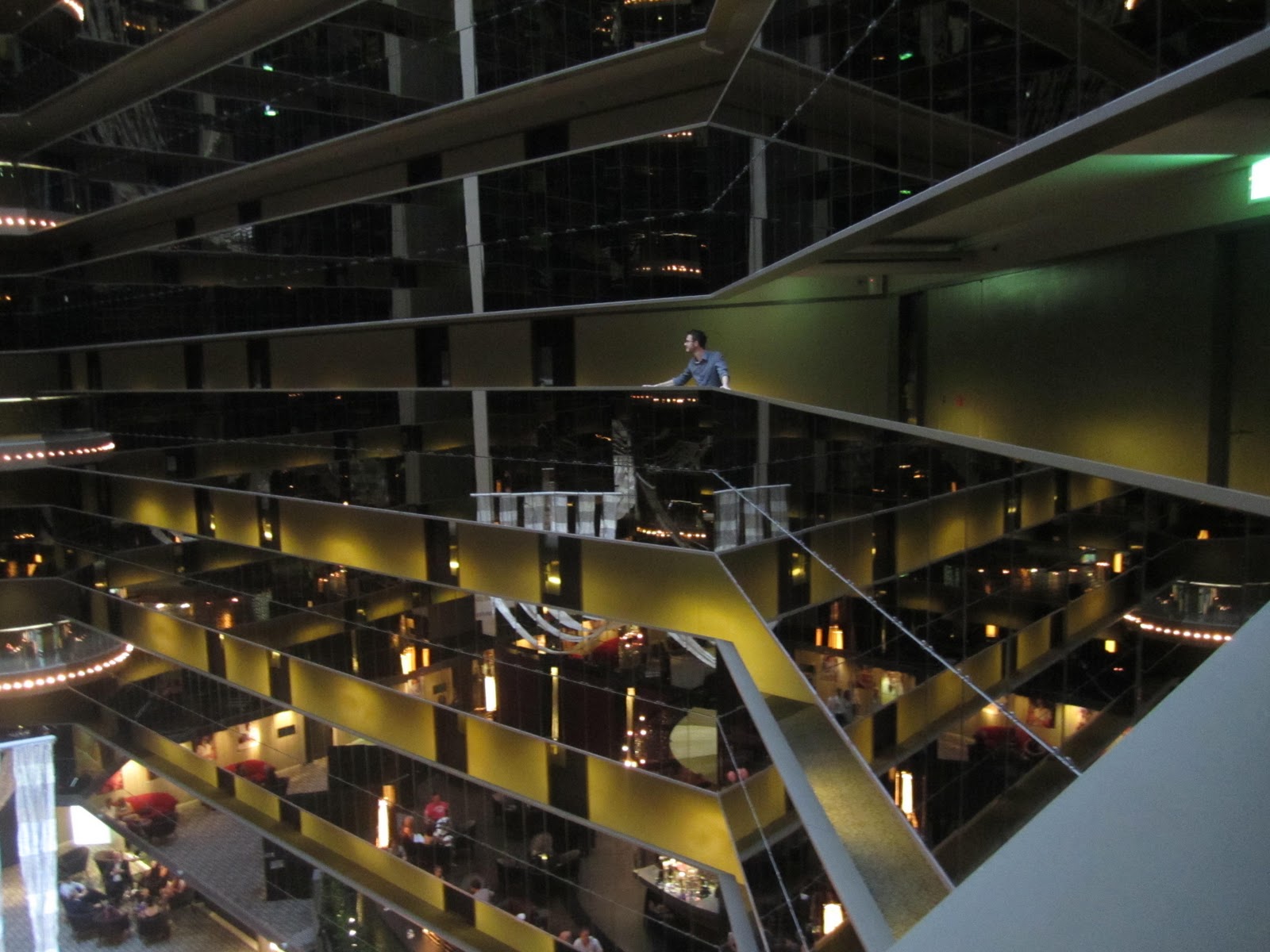
Without wishing to brag, the Sofitel Melbourne on Collins is an awesome, towering, opulent, art deco behemoth made mostly out of dark glass with a central twenties-style lounge and restaurant with overhead awnings that cascade from the very top of the building, some 50 storeys up. It’s times like this when a man needs a top hat. All of which starts on the 35th floor, while the escalator offers no option to exit on any of the subsequent storeys. I'm always slightly unnerved by this sort of anomaly, of confounding space and structure, like when you discover a mysterious gap or space in your home with no entry point that doesn’t seemingly serve any particular purpose. What the hell are they doing down there, and why do they need 34 floors to do it?

Our room is on the 39th floor, but it might as well be on the moon. Apparently, one of Melbourne’s main tourist spots is the Eureka Skydeck 88 (so-called because of the number of floors), where you can not only pay for a hair-raising view of the city from the “highest viewing platform in the southern hemisphere”, but also opt to enter a glass cube which projects 3 metres out from the building. Feeling that $17.50 is a tad too much to ask for essentially vomiting in a box, the view from the Sofitel would have to do, and what an epic sight it is. The picture below looks out to the north of the city - the mock gothic church is St Paul’s Cathedral, built on the site of Melbourne’s first Christian services in 1836; in the centre is a slightly obscured Parliament House, and that rotunda in the top left forms the roof of the Royal Exhibition Building in Carlton Gardens, which seems a more than apt place to start.


Following the European tradition of international exhibitionism, this massive 12,000 square metres of Florentine inspired space was feverishly constructed in 1880 to host the country’s second international exhibition. With Sydney hosting the event the previous year, this exhibition could arguably be seen as the arrival of Melbourne as Australia’s second city. Unlike Sydney, Melbourne was never settled as a penal colony, but instead made prosperous by the good entrepreneurial fortune of auspicious gold diggers. The Victorian gold rush of the mid-1800s would triple the city’s population, leading to huge migrant communities in pockets of the city that have continued to develop and prosper to this day. The Melbourne International Exhibition would go on to attract 1.5 million visitors, at a time when Melbourne’s population was 280,000.

My favourite story regarding the development of Melbourne regards settler John Batman, who famously purchased 100,000 acres of land from the Aborigines in an 1835 treaty which must surely be one of the earliest acknowledgments of indigenous land rights. Granted, Batman only rented the land on an annual basis in exchange for “40 blankets, 30 axes, 100 knives, 50 scissors, 30 mirrors, 200 handkerchiefs, 100 pounds of flour and 6 shirts,” but as my trusty guide book identifies, “the fact he bought the territory (…) rather than simply stealing it, was a rare occurrence for the period.” And what would he call such a wondrous new acquisition? 'Batmania', of course. Brilliant.

Unfortunately, the stuffy traditionalist Sir Richard Bourke, who was Governor of New South Wales at the time, stepped in while Batman was dying of syphilis to instead christen the town Melbourne, after Lord Melbourne, or William Lamb, the British Prime Minister (pictured). In his middle age, Melbourne, a Whig, developed a closeness to the young Queen Victoria and a penchant for spanking sessions with aristocratic ladies which is clearly a topic for a completely separate blog post, one that I'm sure we will eagerly return.

Nowadays, of course, people go to Melbourne to “do shopping”, which at least acknowledges the city’s gold rush heritage with every corner of the consumerist conscience is covered. Even the Sofitel is positioned above a shopping centre, located at the top of Collins Street where the Church of Scientology makes comfortable bedfellows with the Church of Louis Vuitton. The major drawback of any capitalist structure is how every city street appears to have turned into endless, identikit malls of Prada and Mcdonalds. Melbourne could be Rotterdam, or anywhere.

But forgive the thought, as Melbourne is still an invigorating, lively and genuinely welcoming place, nothing nearly as staid as Sydneysiders claim, although the changeable climate seems to be an acknowledged truth: following the peak temperatures of New Year’s Eve, the following day reached only 17. It even rained. No, worse: it drizzled. ‘Four Seasons in One Day’, as Crowded House once sang. Victoria is the size of Great Britain, and with all the Victorian architecture and bad weather, it’s enough to make a pom quite homesick.

As for the touristy things, visiting a Victorian prison may seem like a particularly unpleasant thing to do on New Year's Day - and of course you would be right - but we reached the decision on the basis of two quite polarising figures in Australia’s history. Captain Cook, whose stone cottage was transported brick by brick from Yorkshire in 1934 to a location just down the road from our hotel, and Ned Kelly, the metal-headed bush-ranging so-and-so who was executed at the Old Melbourne Gaol in 1880. My girlfriend’s patriotism won out: “why would I want to see where Captain Cook lived? He wasn’t even Australian.” Well, quite. How dubious an honour of posterity when you discover a nation and still lose in a popularity contest with a gun-slinging murderer. I should probably add here that, as it happens, the cottage actually belongs to Cook’s parents and there is no evidence that Cook ever lived there. I failed to raise this fact with my girlfriend for fear of tarnishing the man’s reputation further.

I won’t go into too much detail regarding Kelly for fear of repeating my previous blog post, but mainly because the story of the Old Melbourne Gaol is such a ghastly one that it extends way beyond the Kelly mystique. For starters, Kelly was only one of over 130 prisoners who were executed on these grounds. You can still see the gallows, follow Kelly’s final steps, take part in a trial re-enactment, and poke your head into each of the damp, cramped, stony cells, which now speak of graphic tales regarding child killings, prostitution, opium dens and murder, the incriminatory backlash to the desperate slum life of Melbourne’s over populated gold rush communities. Happy new year, by the way.

Opening in 1841, the first public execution to take place here was in 1842, and a dogged mess it proved to be. ‘Bob’ and ‘Jack’ were Aborigines, sentenced for the murder of two whalers. Given the manner of using prisoners as executioners, the job fell to John Davies, a shoemaker who stole a sheep in England and ended up on a ship to Sydney. In exchange for a limited pardon and ten pounds, Davies pulled the lever, only the drop failed to fully open. The scaffold had to be repaired while the two men were left choking. Davies was paid only five pounds and his freedom was refused.

The horrific stories continue in this vein: stories of female ‘baby farmers’ who were taken to the gallows with a drawstring around their skirts to stop their dresses from billowing as their bodies fell. Capital punishment was abolished in Victoria in 1975, and the Gaol chooses to focus predominantly on tales of grave social injustice, like the death of 65 year old Basilio Bondietto, a charcoal burner accused of murder who spoke no English and had no interpreter at his trial. Or the story of Colin Ross, blamed for the death of a 12 year old girl on the evidence of hair strands found on Ross’ bed, despite his continuous protests of innocence. This was the first use of forensic science in a murder trial and, thanks to the reopening of the case in the late 2000s, the investigation proved that scientists at the time had got it wrong. Very wrong, actually, as Ross was sent to a slow death in 1922, taking somewhere between eight and 20 minutes to die. His last words were, "I am now face to face with my Maker, and I swear by Almighty God that I am an innocent man." Ross would prove to be the first Australian to receive a posthumous pardon.

You won’t need long within the Gaol's confides to satisfy all of your morbid curiosities, especially when you see the prisoner’s death masks. These are moulds of the prisoner’s faces made soon after execution (Ned Kelly's is pictured), which was a standard practice for phrenologists to investigate and draw their nonsense conclusions. Phrenology is pretty much discarded now as a scientific study, in which it was argued that criminology could somehow be hardwired into your neurological make up rather than taking into account things like upbringing and mental health. The waxwork heads of executed prisoners is disturbing enough, but what really concerns is a simulated miniature hangman structure where groups of children are encouraged to push a button and watch as a plastic figurine drops through a hatch, attached only by the hangman's noose. The punishing vigour possessed by some of these children was really quite remorseless. Lets hope they can eventually be coaxed into an alternate career path.

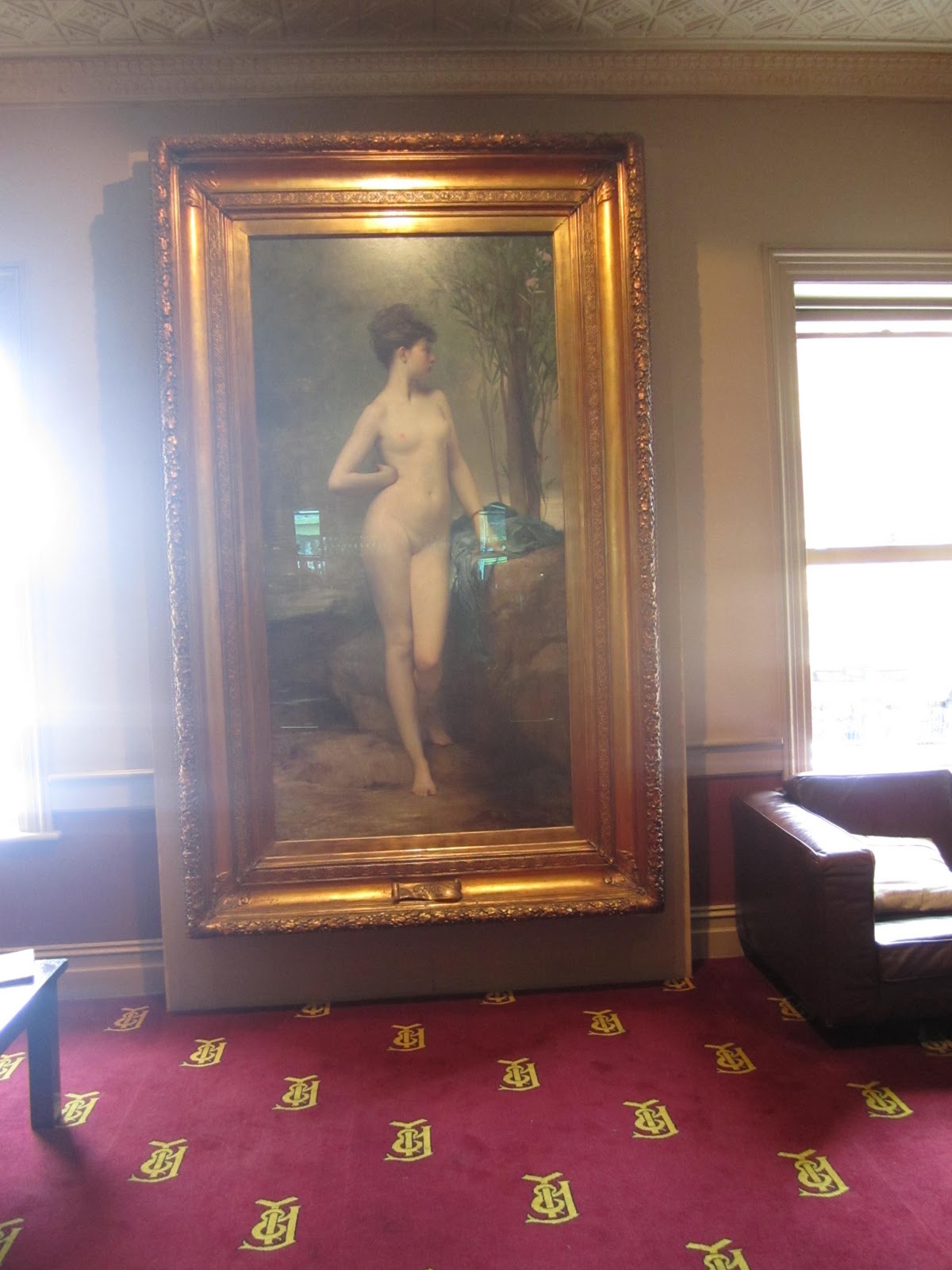
Let us close on a more comforting thought. The portrait pictured on the right is called Chloe, and can be found upstairs in the innocuous setting of Victoria’s oldest pub, the Young and Jackson, opposite Flinders Street station. Originally owned by John Batman as the site for Melbourne’s first schoolhouse, it was established as a pub and hotel in 1861 and bought by two Irishmen in 1875, Henry Young and Thomas Jackson. Young bought the Chloe portrait in 1909 to add to his growing art collection, and she has become a sort of naked mascot for the city ever since. Those closeted Victorians from the 'Ladies Branch of the Anglican Social Purity' caused much harrumphing when Chloe debuted at the National Gallery of Victoria in 1883 and was exhibited on a Sunday. She was stripped down, if you will, after only three weeks.

Chloe was painted by Jules Joseph Lefebvre in 1875 and depicts a passage from a Andre Chenier poem regarding a lady who hears the beckoning call of her lover from behind the trees. Quite why she's completely starkers in the middle of the woods is a bit of a headscratcher, but I can tell you that the model is a 19 year old Parisian called Marie. Seeing such a striking painting in the top room of what essentially feels like a Wetherspoons is a bizarre but beautiful surprise. Tragically, two years after Chloe was painted, the model Marie committed suicide. She boiled poisonous matches and then drank the fatal concoction. I'm sure you can probably order something similar at the bar.

Tuesday, 4 January 2011

Wet Christmas

In hindsight, that bit last week about Bundaberg reaching 28 degrees on Christmas Day might have sounded a tad optimistic, but it did actually reach a top of 29 degrees, if only combined with the city’s worst flooding since 1942.

The seriousness of the situation was only brought home when we saw that American networks like CNN were running reports: 200,000 people affected; 22 towns and cities inundated or isolated; forced evacuations; affecting an area larger than France and Germany combined. Combined. And in some places, it’s only getting worse.

We’re a week out and Bundaberg still resembles a lumpy soup. At its height, a third of the city was under water, forcing nearly 400 people to be evacuated. The Burnett River - usually looking resplendent with moored boats, hundred year old bridges, daily trawlers of sea-faring fish folk and the sweet smell of molasses from the sugar plantation carried on the cool breeze - rose to a peak of 7.9 metres, swamping everything I just mentioned along with it. Aviator Burt Hinkler famously flew his aircraft underneath Bundaberg's old railway bridge: if he was still around to do it this year, he’d need to pack a snorkel.

The city of Rockhampton, around 300 km north of Bundaberg, hasn’t yet reached the height of its problems, with the Fitzroy expecting to peak at 9.4 metres tomorrow, taking hold of nearly 50 per cent of the city. The Herald Sun in Melbourne highlighted another rather terrifying prospect for those residents currently swimming away from their possessions and towards drier confines. Wendy Hilcher is an ambulance officer for the RSPCA, who has been rescuing people’s pets all week, but an attempted rescue on Sunday was aborted when she noticed a crocodile in the water. Brown snakes have also been spotted. “It's not just the safety aspect of getting to these places, it's what's in the water itself,” she said.

Scenes of cataclysmic flooding is a particularly familiar media sight nowadays: cars breached with only their rooftops on show; the two-way reportage with bone-dry journalists, usually with a lake in the background which used to resemble a shopping centre; then into the houses, where a defeated couple sludge through their possessions, some even managing a weary note of optimism: “I’ve never seen it this bad,” or “it’s a good job we’ve got some Wellies.” My girlfriend's reaction to seeing her old netball courts - the ones she played on as a child - completely submerged sparked a clearly more personal response. And expletive, it would seem. Once safe in Brisbane, she could only gasp in horror at the scenes unfolding, saying the word ‘shit’ repeatedly.

Complete helplessness, and a sort of resigned acceptance; those were my feelings when the rain hadn’t stopped since we had arrived a week previously on Christmas Eve. Quite alarmingly, we were told when we arrived that it had “been like this for two weeks,” and many agreed that, yes, they had never seen it this bad.

There is science behind all of this, by the way, as the east coast of Australia is currently enjoying a particularly severe La Nina affect (the opposite of an El Nino), which has something to do with cooler temperatures in the Pacific Ocean that has caused Queensland’s rainfall to increase by six times over the December average. But when you’re there, in a state of limbo, during a religious festival, facing the relentless pitter-patter and steady drowning of a quiet country sugar town, you can’t help but feel a significant biblical overtone - real Old Testament stuff, that of great plagues, vengeance, apocalypse. The relief of having a one year old in our midst with the name Noah was at least a little reassuring.

As rivers swelled, peaked and spilled, the main concern was a swift exit from Bundy before high tide hits, the only roads are blocked and we’re done for. The house suddenly resembles a particularly serious scene from ‘CSI: Bundaberg’ with would-be forensic experts on the phones to police advice bureaus and relatives surveying the ground for clues, analysing depths and water gages like trainee meteorologists, discussing locations of evidently severe importance: “Kendall’s Flats is totally under,” says one. “McCoy’s Creek is up. If you get through the Isis in South Childers there’s further damage at Maryborough with the Bruce Highway blocked towards Gympie.”

We were restless, awaiting a parting of the waves, eventually fleeing a derelict scene just before the air lifting started. And if you need further proof of Australia’s vast meteorological unpredictability, when all of this was happening, a heat wave in South Australia saw temperatures reach 43 degrees. In Bundaberg, however, you could forget goannas running up gum trees, or even cricket in the garden, as the constant rain ultimately proved the season to be not too dissimilar from a damp, traditionally English Christmas.

Here are some more of our Bundy Christmas photos.


And my personal favourite...

Thursday, 23 December 2010

Mistletoe and Strine

TM would like to wish everybody a merry Christmas, regardless of hemispheres, and regardless of snow storms. I’ll be in Bundaberg on Christmas Day where the temperature will allegedly reach 28 degrees. To build up anticipation, we’ve been listening to A Bush Christmas at work, a dubious collection of Christmas music done in an Aussie country style. The irony of singing ‘White Christmas’ is not lost on the Australians, so over the decades, a glut of sensitive, romantic, colloquial but mostly funny seasonal songs have been created to better suit the temperament (and temperature) of the people. Here are some of TM’s favourites.

Rolf Harris - ‘Six White Boomers
A zoo-bound joey spots Santa on his Christmas run being led by six old kangaroos (‘white boomers’), and because ol’ Nick is in a particularly giving mood, he decides to extend his stay Down Under an extra day to help reunite the baby with its mother. “The last they saw was Santa heading northwards from the sun/the only year the boomers worked a double run.”

John Williamson - ‘Christmas Photo
Williamson’s Christmas Day revolves around the pressure of getting everybody to pay attention long enough to take the family photo. The grandkids are surprised to see Santa’s big black boots “in the back of Jacko’s ute”, the ladies do the cooking while the men play cricket. Then a goanna runs up a gum tree (this happens a lot in Williamson songs), feeding on leftover chook and cake. And if you were wondering, yes, they do take the photo in the end. But, “hang on Dad, where did Sam go?”

Paul Kelly - ‘How to Make Gravy
I went to a Paul Kelly Q&A recently where the singer-songwriter discussed his autobiography and explained in detail this particular Christmas commission. “I’ve got one,” he said to the producers, “but it doesn’t have a chorus and it’s set in prison.” The lamenting story of a prisoner writing to his brother about missing his family at Christmas time would go on to become Kelly’s biggest hit. “I guess the brothers are driving down from Queensland and Stella’s flying in from the coast,“ he sings, “They say it’s gonna be a hundred degrees, even more maybe, but that won't stop the roast.” The pressing concern is who will make the gravy in his absence? “I bet it won’t taste the same.”

John Wheeler - ‘The Three Drovers
A bush poem from 1948, here’s a not untypical romantic verse regarding three Aussie drovers, who herd sheep and cattle at Christmas time through “dry summer heat” with “smoke on the yellow moon”, when they spot a “starry lustre blazed on high/Still echoed on the heavenly strain,” and recognising religious iconography when they see it, start up a chorus of ‘Noel’ as they continue their amble. It’s the Wise Men parable ascribed to Australia’s most cherished and inspiring image of the brave, pioneering stockman in a vast and insurmountable wilderness, a vision which was channelled by a number of poets during the age like the equivalent of Wordsworth’s daffodil.

Bucko & Champs - ‘Aussie Jingle Bells
A staple summer Christmas to the tune of Jingle Bells: “Kelpie by my side/Singing Christmas songs/It's summer time and I am in my singlet, shorts & thongs.” You might need your Strine dictionary to work out what on earth Bucko & Champs are going on about, particularly with talk of swaggy climbs and kelpies. But you get the idea. All together, then: “Jingle bells, jingle bells, Christmas time is beaut’/Oh what fun it is to ride in a rusty Holden ute.”


I see that Channel 4 are showing Carrie in the early hours of Boxing Day. That's like putting The Exorcist on Good Friday. Carrie's blood curdling tale of bitter retribution succeeds a seemingly unremarkable folly of programming, the best of which seems to be a new ‘Poirot’, a new ‘Doctor Who’ and the obligatory ‘Eastenders’ special. To be fair, that’s the only episode of the show I’ll actually watch. Let’s hope the producers have taken Channel 4’s lead in turning bullied Billy Mitchell into some possessed Carrie-like devil child, exacting his bitter vengeance against all of Walford by spewing his guts in the Queen Vic. More potatoes, Gran?

Australia’s 7Two have been showing a run of Christmas Specials. I was quite excited to see a ‘Jonathan Creek’ special featuring Bill Bailey until it quickly became apparent that it was made in 2001. The mobile phones were a dead giveaway. Continuing the bygone theme, this Christmas Day they’re showing ‘One Foot in the Grave’, ‘Keeping Up Appearances’ and - I’m not making this up - ‘Love Thy Neighbour’. The popularity in this country for dead 70s Britcoms is quite baffling. The still resonating appreciation for ‘The Goodies’, in particular, is quite perplexing.

But the big clinchers on Christmas Day will be a ‘Spicks and Specks’ Christmas special, a TV movie of ’Anne of Green Gables’ and ‘The Graham Norton Show’, which may not all be riveting, but are at least from this current millennia. And we get the Queen’s speech in the evening over here, which is just in time for the ‘Extras’ Christmas special. From 2007.


Congratulations to Kim Fredericks of 253 Formosa Road, Gumdale, who has been crowned the Brisbane East division winner of the 2010 4KQ Christmas Lights Competition, pictured above. Incorporating more than 70,000 lights, Mr Fredericks orders new bulbs in July and spends over 280 hours (nearly two weeks) preparing the display. The cost of the lights is around $30,000, while December’s electricity bill is $500. No doubt the prize money of $1000 will come in handy.

Henry and Mary Cichowski, of Kuringal Drive in Ferny Hills, have been building on their light display for seven years. “It takes me four and a half weeks to put it up,” said Mr Cichowski. But the real Christmas crackers are 70-somethings Walter and Beverley Wood of Kenmore (pictured below), who were crowned Brisbane West division champions for the 20th year in a row. Attendances at their suburban display reach upwards of 3000 people a night, with visitors travelling from as far flung locations as Lismore and Rockhampton. To put that into perspective: according to Google Maps, Rockhampton to Kenmore will take you 7 hours and 49 minutes in a car. One way.
“Every year people tell us that we can't possibly ever do better - but every year we manage to come up with something new,” said Mr Wood, who also won Best Lighting Display at the awards. The full winners list is here, if you care, and is considerably more extensive than you would ever have thought possible, with geographical distinctions and categories like Best Use of Recycled Materials, Best Logo Display, and the enticing achievement of entering the Bill Stratton Hall of Fame. While Michael and Jessica Sallaway of 2 Childs Street, Rochedale South, winners of the Best Synchronized Music & Lights Display, should seek inspiration from this for next year’s competition - perhaps the single greatest combination of the spirit of Christmas and the music of Slayer.


Which thankfully leaves enough room for my favourite Christmas joke. Santa Claus goes to the doctor and says, “Doctor, I think I have a mince pie stuck up my bottom.” The doctor quickly investigates and says, “Yes, indeed you do Mr Claus, but don’t worry, I’ve got some cream for that.”

Merry Christmas.