Thursday, 20 January 2011

Four Seasons in One Day: Welcome to Melbourne (Part II)

In January 1990, there was a bit of an incident involving a limestone formation on the coastline of the Port Campbell National Park in the very south of Victoria. Called London Bridge - named after its rocky resemblance to the English landmark - an eroded section connecting the faraway point of the stack to the shoreline dramatically collapsed into the sea. This is pretty much academic to anyone with even a basic grasp of how the world is formed, but here’s the interesting bit: two people were on it at the time.

To come so close to death’s squelchy grasp and survive is one thing, but to pray witness to such a shape shifting event is quite another; the moment when an area of Victoria just disappeared into the ocean. Of course, land patterns aren’t permanent no matter where we draw the line, and more limestone will be chipped away and eroded to equally dramatic effect in the ensuing years, transforming cliffs into caves, caves into arcs, arcs into stacks, and stacks into the inevitable absorption of the sea. Nowadays, London Bridge is known as London Arc. Pretty soon, it will just be ‘London’. Then ‘Lon’. Then nothing.

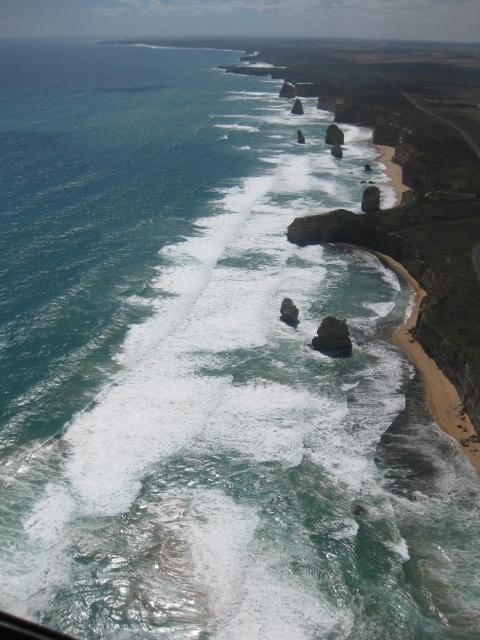
Which makes the lauded Twelve Apostles even more dramatic, especially if coastal morphodynamics is your thing. These are a series of limestone stumps dotted along the Victoria coastline, although there seems to be some contention as to where the name comes from, because no matter how many times you count them, there is still clearly seven of them. There were eight, apparently, although one of them gave up somewhere in 2005.

Nowadays, you can choose to pay a healthy sum to take a ten minute helicopter ride over the Twelve Apostles and see the diminishing attributes of Mother Nature in all her tempestuous, foamy glory. It’s worth doing, because you get views like the ones I have attached. We also check out the structures at ground level from the designated viewing plinth, but after a ride in the chopper, that’s basically the equivalent of starting a meal with your pudding.


Anyway, back to those stranded souls who found themselves, quite literally, on the precipice of an earth-shattering event. This is where I will introduce Matt, our tour guide, who makes no qualms regarding the volume of the music in his minibus. “The speakers are right at the back so I have to have it on pretty loud,” which is at least some form of an excuse. He sports a porkpie hat in the manner of a singer from a ska band: Buster Bloodvessel, without the cholesterol. It’s not the volume of the music that’s striking, but rather his choice of songs. Matt makes a habit of accompanying his storytelling with tactful musical referencing. Which explains why our descent from London Arc is accompanied by the apt sounds of Fontella Bass singing ‘Rescue Me’. (This is quite a fun game for anyone with time to spare on a shuttle bus: we decide that he could just as easily opted for ‘Bridge Over Troubled Water’, ‘Stuck in the Middle with You’ and, of course, ‘Help!’).

The dramatic beaches near Port Campbell are also infamous as the residual resting place of 19th century shipwrecks which still pot mark the treacherous landscape of Wreck Beach. The Victoria gold rush of the industrial age brought as many as 100 ships a day from Britain to Melbourne full of eager prospectors, and up to 200 ships would meet their end in these waters, trickily navigating the 80km channel between the Bass Strait islands and the limestone sea stacks. One sea weary captain at the time described navigating this passage as being like "threading a needle".

This is where you can still find the rusted anchor of the Marie Gabrielle, a French vessel which ran aground in 1869, and the British steamer Fiji which hit the rocks in 1891 killing its entire crew. “For the impoverished coastal farmers, any wreck was a tragedy, but it could also be like Christmas,” writes Tony Perrottet in The Weekend Australian. “The locals descended in droves to pillage the Fiji for its wood and cargo: liquor, European clothes, porcelain, toys, even a couple of grand pianos.” We do manage to get down and see Loch Ard Gorge, a violent swell of tortuous sea and shaggy rock which would prove fatalistic to a British ship leaving Gravesend in 1878 with its sight set on Melbourne. Only two would survive the famous Loch Ard crash out of the 54-strong crew, including a boy, Tom Pearce, who miraculously managed to land on the only patch of sand in the gorge.

Pearce heard the screams of another passenger, Eva Carmichael, clinging to a chicken coop. She was rescued, and Pearce somehow managed to scale the high cliffs to alert the villages of the disaster (there are some stairs there now, including a handrail). Despite calls from the press for the two to be engaged, Pearce returned to a life at sea where he later found himself the victim of two more shipwrecks before deciding that enough was, indeed, enough.

The reason you can’t just walk down to the fabled Shipwreck Coast is because it’s officially outside of the Great Ocean Road tourist trail. In fact, the cliff tops would prove so overbearing for even the road’s builders that they were forced to make an inland detour around Cape Otway just to avoid it. The Great Ocean Road, Australia’s most scenic route, is some 270km long (nearly 170 miles) and every inch of it was constructed by hand without the aide of explosives or machinery. The Memorial Arch in the town of Anglesea explains how the road was eventually completed in 1932 by some 3,000 soldiers returning from the First World War, a war in which Australia would suffer the highest casualty rate out of all the allied forces: somewhere around the 64% mark. Returning soldiers seeking employment in 1918 were put to work building the road and paid well for the trouble. Matt plays Sheryl Crow singing ‘Every Day is a Winding Road’ as the bus shimmies through a breathtaking, industrial masterpiece.

Matt does three driving tours a week and he’s been up since 5am this morning. “I’ve done this tour so many times I can do it in my sleep,” he says encouragingly, adding, “that’s why I wear the sunglasses.” He drives us through Geelong, which could have been the equivalent of what Melbourne is today if the city's bay was big enough to accommodate larger ships, and then onto Torquay, which is officially where the Great Ocean Road starts.

Australia’s Torquay has a proud heritage to rival that of England’s Torquay, which is now destined to forever be associated with Helen Chamberlain and ‘Faulty Towers’. Torquay is the surf capital of Australia, not only the home of the Quiksilver and Rip Curl brands, but also Bells Beach, which even I had heard of; probably something quite rare for someone with a complete aversion to swimming in the ocean. Quite coincidentally, I can pinpoint the blame for this to a holiday in Torquay, England; braving the bitterly cold, litter-strewn sea while dodging a spare jellyfish. In hindsight, it is unlikely that this was a jellyfish, and was probably a plastic bag of some kind, submerged amongst the dank swell, but still the fear remains.

Bells Beach is mentioned in the film Point Break, you see, which had Keanu Reeves and Patrick Swayze cast as quite believable surfies, and is now probably old enough to be deemed ironic. “I watched it again recently,” Matt says over his microphone, “I thought it was better in the 90s.” Matt’s derision doesn’t end there: the climax of the film sees the two central actors go to Bells Beach to tackle a once in a lifetime killer wave, dude, but the scene was actually filmed in Portland, Oregon. Bells is still the only certified surfing recreational site in the world, with rights in place to protect the area from damage to the environment. I’m guessing this must have been before that big car park was built, with space to accommodate a daily turnover of ogling tourists, which is certainly something to dwell on as we hit the road again and Matt blares out the greatest hits of The Beach Boys.

The Great Ocean Road is a thing of such sweeping, epic and romantic splendour that it rightly resides as one of Australia’s Top Things To See. It is a dramatic achievement as both a memorial for the country’s fallen soldiers and as a testament to the majestic landscape of which they would never return, sacrificed in the murder of Gallipoli and beyond. Through their commemorations, the road has opened a once remote expanse of coastline to celebration from people all over the world, and that is a splendid thing.

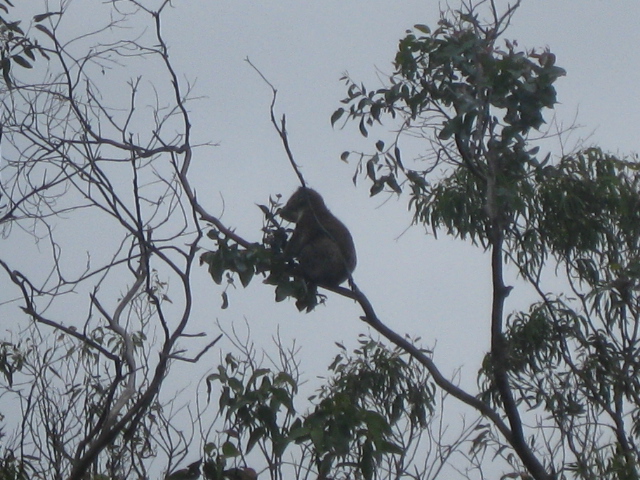
The iconic images of the Apostles may end the trail, but there is much wonder to explore along the way; from the beach town of Lorne, home of the Lorne Pier to Pub Swim (surely only in Australia could a sporting event end in a pub?), to the Kennett River Holiday Park where rosellas and koalas abound, and the Maits Rest Rainforest Walk where slender mountain ash trees stretch to their astronomical heights - the tallest recorded at just under 100 metres. Matt’s whistle-stop tour makes an orchestrated stab at catching a glimpse at all of this wonder in a single day, which is no mean feat, and we return to the hotel exhausted.

“Thank you Matt,” we offer, “and get some rest.”
“Can’t mate,” he says, “I’m up at 5am tomorrow to get to Phillip Island.”
Poor guy. He’s had a hard day’s night.

Tuesday, 11 January 2011

Four Seasons in One Day: Welcome to Melbourne (Part I)

From some of the worst flooding in Queensland’s history we fly south to Victoria and arrive during a Melbourne heat wave. It’s New Year’s Eve and a flashing sign on the Tullamarine Freeway reads ‘Fire Ban Today’ in bright orange letters - but how do you even begin to police something like that, I ask the taxi driver, a Czech migrant who has been living in Melbourne since the late 1960s. I won’t do the accent. “You find that some people will still start a barbecue,” he says. “But just look at this scrub,” he gestures to the embankment. “It is so dry that you only need a tiny flame and, woosh, the whole area will be up.” He thinks even the famous end-of-year fireworks over the Yarra River might be cancelled. But that’s why we’re here. Surely not?

By 6pm, the city has reached a temperature of 41.1. Hopetown Airport records the day’s highest at 43.3. The bitumen in Dandenong has started to melt, and a fire breaks out at Boolite which, according to the Herald Sun, burns 100ha of bush land. That’s 1 million square metres. That’s nearly 250 acres. That’s rather big. But it’s a mere tree in the woods compared to the events of February 16th 1983, Ash Wednesday, when more than 180 fires raged through parts of Victoria and South Australia, obliterating nearly 520,000 acres of land. When the summer had ended, 1.25 million acres in Victoria and South Australia had been destroyed, and 75 people killed.

Given such a catastrophe, when state premier John Brumby predicted that the bush fires on Saturday February 7 2009 would cause the “worst day in the history of the state,” there were over 3,500 fire fighters across Victoria on guard for Mother Nature’s worst. “People need to exercise some real common sense tomorrow,” he said the day before events which will now be forever remembered as Black Saturday.

On that day, the temperature in Melbourne reached an all-time record of 46.4, the culmination of a week long heat wave following nearly two months of little or no rain, coupled with wind speeds of 75mph. By the end of Black Saturday, the death toll had reached 173 people, with 120 killed by a single firestorm. The ferocity of the gale force winds carried the blaze at such alarming speeds that, in many cases, most of the victims had little or no time to react. Bodies were later discovered near their cars or outside their homes.

Black Saturday encompassed 400 individual fires, nearly three times as many as Ash Wednesday, and although many of the fires were caused by falling power lines, reports told of human misdemeanor: a cigarette butt in West Bendigo sparked a fire killing two people and destroying 50 homes. In Marysville, a deliberately lit fire at a saw mill caused the eventual devastation of 80 per cent of the town.

I can’t say that I have ever experienced such searing heat as New Year’s Eve in Melbourne: an oppressive roasting, like being oven baked only without the humidity and comfort of a brief reprieve to be pricked or marinated. It was certainly dry enough to be concerned by the eventual presence of fireworks. Despite the precautions, the banks of the Yarra still swelled with 500,000 revellers, myself included, arching our necks to ‘ooo’ and ‘ahhhh’ at the colourful whizzes and bangs emanating from the rooftops of the city’s tallest buildings. It was an invigorating display in a beautiful setting, but then, forgive me, there is something about fireworks that makes me go all reflective, gooey-eyed and childlike. Blame those Bonfire nights and funfairs of old, which might explain why I always associate fireworks with the taste of honeycomb. Weird, but there you are.

We could see our hotel from the Yarra on Southbank, although there aren’t many places where you can’t see it (it's the third building from the right on the very first picture). Being on a city break and feeling slightly frivolous, we had secured three nights in a Sofitel, and although I’m not completely certain of the criteria required for a hotel to warrant a five star distinction, my feeling is that a Pillow Menu is up there (one that includes the options of foam, feather and Tontine latex). Plus the option of a Champagne breakfast. And a personal massage therapist ordered to your room, as long as you realise that the subcontracted Merkas Health is a “strictly non-sexual service”. This bit had been written in both bold and capital lettering, as if this was the sort of routine misapprehension that really needed to be stressed.

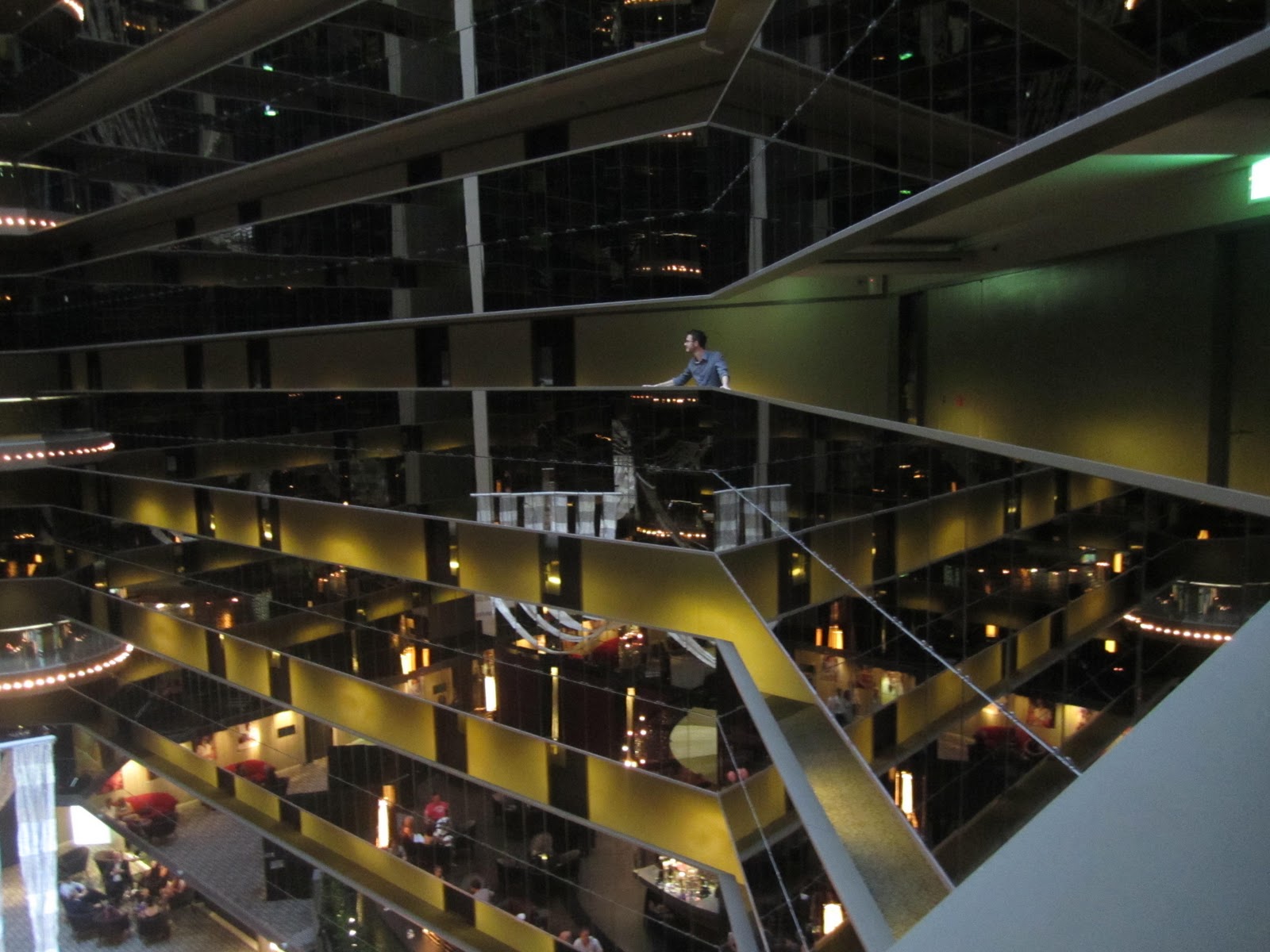
Without wishing to brag, the Sofitel Melbourne on Collins is an awesome, towering, opulent, art deco behemoth made mostly out of dark glass with a central twenties-style lounge and restaurant with overhead awnings that cascade from the very top of the building, some 50 storeys up. It’s times like this when a man needs a top hat. All of which starts on the 35th floor, while the escalator offers no option to exit on any of the subsequent storeys. I'm always slightly unnerved by this sort of anomaly, of confounding space and structure, like when you discover a mysterious gap or space in your home with no entry point that doesn’t seemingly serve any particular purpose. What the hell are they doing down there, and why do they need 34 floors to do it?

Our room is on the 39th floor, but it might as well be on the moon. Apparently, one of Melbourne’s main tourist spots is the Eureka Skydeck 88 (so-called because of the number of floors), where you can not only pay for a hair-raising view of the city from the “highest viewing platform in the southern hemisphere”, but also opt to enter a glass cube which projects 3 metres out from the building. Feeling that $17.50 is a tad too much to ask for essentially vomiting in a box, the view from the Sofitel would have to do, and what an epic sight it is. The picture below looks out to the north of the city - the mock gothic church is St Paul’s Cathedral, built on the site of Melbourne’s first Christian services in 1836; in the centre is a slightly obscured Parliament House, and that rotunda in the top left forms the roof of the Royal Exhibition Building in Carlton Gardens, which seems a more than apt place to start.


Following the European tradition of international exhibitionism, this massive 12,000 square metres of Florentine inspired space was feverishly constructed in 1880 to host the country’s second international exhibition. With Sydney hosting the event the previous year, this exhibition could arguably be seen as the arrival of Melbourne as Australia’s second city. Unlike Sydney, Melbourne was never settled as a penal colony, but instead made prosperous by the good entrepreneurial fortune of auspicious gold diggers. The Victorian gold rush of the mid-1800s would triple the city’s population, leading to huge migrant communities in pockets of the city that have continued to develop and prosper to this day. The Melbourne International Exhibition would go on to attract 1.5 million visitors, at a time when Melbourne’s population was 280,000.

My favourite story regarding the development of Melbourne regards settler John Batman, who famously purchased 100,000 acres of land from the Aborigines in an 1835 treaty which must surely be one of the earliest acknowledgments of indigenous land rights. Granted, Batman only rented the land on an annual basis in exchange for “40 blankets, 30 axes, 100 knives, 50 scissors, 30 mirrors, 200 handkerchiefs, 100 pounds of flour and 6 shirts,” but as my trusty guide book identifies, “the fact he bought the territory (…) rather than simply stealing it, was a rare occurrence for the period.” And what would he call such a wondrous new acquisition? 'Batmania', of course. Brilliant.

Unfortunately, the stuffy traditionalist Sir Richard Bourke, who was Governor of New South Wales at the time, stepped in while Batman was dying of syphilis to instead christen the town Melbourne, after Lord Melbourne, or William Lamb, the British Prime Minister (pictured). In his middle age, Melbourne, a Whig, developed a closeness to the young Queen Victoria and a penchant for spanking sessions with aristocratic ladies which is clearly a topic for a completely separate blog post, one that I'm sure we will eagerly return.

Nowadays, of course, people go to Melbourne to “do shopping”, which at least acknowledges the city’s gold rush heritage with every corner of the consumerist conscience is covered. Even the Sofitel is positioned above a shopping centre, located at the top of Collins Street where the Church of Scientology makes comfortable bedfellows with the Church of Louis Vuitton. The major drawback of any capitalist structure is how every city street appears to have turned into endless, identikit malls of Prada and Mcdonalds. Melbourne could be Rotterdam, or anywhere.

But forgive the thought, as Melbourne is still an invigorating, lively and genuinely welcoming place, nothing nearly as staid as Sydneysiders claim, although the changeable climate seems to be an acknowledged truth: following the peak temperatures of New Year’s Eve, the following day reached only 17. It even rained. No, worse: it drizzled. ‘Four Seasons in One Day’, as Crowded House once sang. Victoria is the size of Great Britain, and with all the Victorian architecture and bad weather, it’s enough to make a pom quite homesick.

As for the touristy things, visiting a Victorian prison may seem like a particularly unpleasant thing to do on New Year's Day - and of course you would be right - but we reached the decision on the basis of two quite polarising figures in Australia’s history. Captain Cook, whose stone cottage was transported brick by brick from Yorkshire in 1934 to a location just down the road from our hotel, and Ned Kelly, the metal-headed bush-ranging so-and-so who was executed at the Old Melbourne Gaol in 1880. My girlfriend’s patriotism won out: “why would I want to see where Captain Cook lived? He wasn’t even Australian.” Well, quite. How dubious an honour of posterity when you discover a nation and still lose in a popularity contest with a gun-slinging murderer. I should probably add here that, as it happens, the cottage actually belongs to Cook’s parents and there is no evidence that Cook ever lived there. I failed to raise this fact with my girlfriend for fear of tarnishing the man’s reputation further.

I won’t go into too much detail regarding Kelly for fear of repeating my previous blog post, but mainly because the story of the Old Melbourne Gaol is such a ghastly one that it extends way beyond the Kelly mystique. For starters, Kelly was only one of over 130 prisoners who were executed on these grounds. You can still see the gallows, follow Kelly’s final steps, take part in a trial re-enactment, and poke your head into each of the damp, cramped, stony cells, which now speak of graphic tales regarding child killings, prostitution, opium dens and murder, the incriminatory backlash to the desperate slum life of Melbourne’s over populated gold rush communities. Happy new year, by the way.

Opening in 1841, the first public execution to take place here was in 1842, and a dogged mess it proved to be. ‘Bob’ and ‘Jack’ were Aborigines, sentenced for the murder of two whalers. Given the manner of using prisoners as executioners, the job fell to John Davies, a shoemaker who stole a sheep in England and ended up on a ship to Sydney. In exchange for a limited pardon and ten pounds, Davies pulled the lever, only the drop failed to fully open. The scaffold had to be repaired while the two men were left choking. Davies was paid only five pounds and his freedom was refused.

The horrific stories continue in this vein: stories of female ‘baby farmers’ who were taken to the gallows with a drawstring around their skirts to stop their dresses from billowing as their bodies fell. Capital punishment was abolished in Victoria in 1975, and the Gaol chooses to focus predominantly on tales of grave social injustice, like the death of 65 year old Basilio Bondietto, a charcoal burner accused of murder who spoke no English and had no interpreter at his trial. Or the story of Colin Ross, blamed for the death of a 12 year old girl on the evidence of hair strands found on Ross’ bed, despite his continuous protests of innocence. This was the first use of forensic science in a murder trial and, thanks to the reopening of the case in the late 2000s, the investigation proved that scientists at the time had got it wrong. Very wrong, actually, as Ross was sent to a slow death in 1922, taking somewhere between eight and 20 minutes to die. His last words were, "I am now face to face with my Maker, and I swear by Almighty God that I am an innocent man." Ross would prove to be the first Australian to receive a posthumous pardon.

You won’t need long within the Gaol's confides to satisfy all of your morbid curiosities, especially when you see the prisoner’s death masks. These are moulds of the prisoner’s faces made soon after execution (Ned Kelly's is pictured), which was a standard practice for phrenologists to investigate and draw their nonsense conclusions. Phrenology is pretty much discarded now as a scientific study, in which it was argued that criminology could somehow be hardwired into your neurological make up rather than taking into account things like upbringing and mental health. The waxwork heads of executed prisoners is disturbing enough, but what really concerns is a simulated miniature hangman structure where groups of children are encouraged to push a button and watch as a plastic figurine drops through a hatch, attached only by the hangman's noose. The punishing vigour possessed by some of these children was really quite remorseless. Lets hope they can eventually be coaxed into an alternate career path.

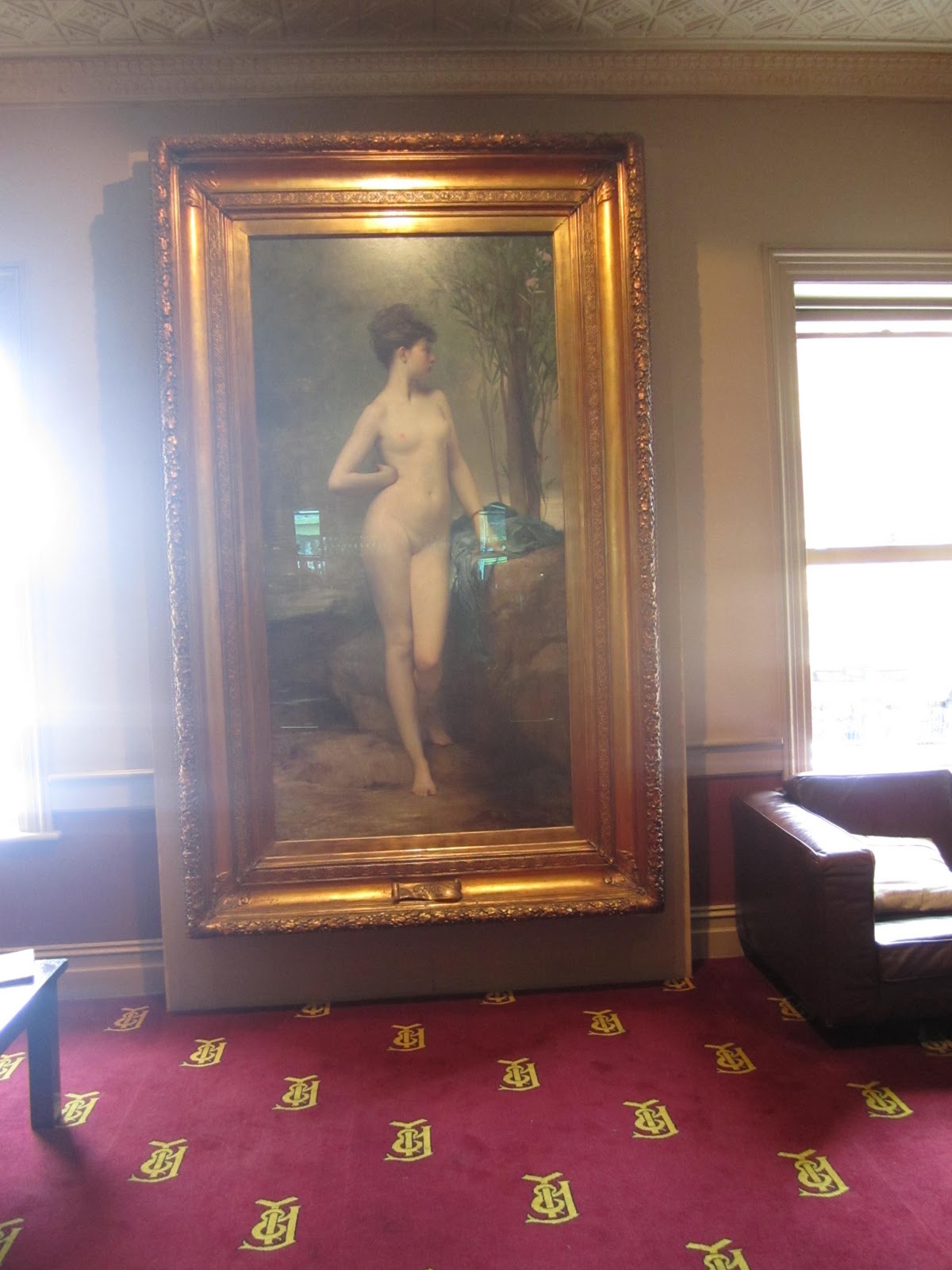
Let us close on a more comforting thought. The portrait pictured on the right is called Chloe, and can be found upstairs in the innocuous setting of Victoria’s oldest pub, the Young and Jackson, opposite Flinders Street station. Originally owned by John Batman as the site for Melbourne’s first schoolhouse, it was established as a pub and hotel in 1861 and bought by two Irishmen in 1875, Henry Young and Thomas Jackson. Young bought the Chloe portrait in 1909 to add to his growing art collection, and she has become a sort of naked mascot for the city ever since. Those closeted Victorians from the 'Ladies Branch of the Anglican Social Purity' caused much harrumphing when Chloe debuted at the National Gallery of Victoria in 1883 and was exhibited on a Sunday. She was stripped down, if you will, after only three weeks.

Chloe was painted by Jules Joseph Lefebvre in 1875 and depicts a passage from a Andre Chenier poem regarding a lady who hears the beckoning call of her lover from behind the trees. Quite why she's completely starkers in the middle of the woods is a bit of a headscratcher, but I can tell you that the model is a 19 year old Parisian called Marie. Seeing such a striking painting in the top room of what essentially feels like a Wetherspoons is a bizarre but beautiful surprise. Tragically, two years after Chloe was painted, the model Marie committed suicide. She boiled poisonous matches and then drank the fatal concoction. I'm sure you can probably order something similar at the bar.

Tuesday, 4 January 2011

Wet Christmas

In hindsight, that bit last week about Bundaberg reaching 28 degrees on Christmas Day might have sounded a tad optimistic, but it did actually reach a top of 29 degrees, if only combined with the city’s worst flooding since 1942.

The seriousness of the situation was only brought home when we saw that American networks like CNN were running reports: 200,000 people affected; 22 towns and cities inundated or isolated; forced evacuations; affecting an area larger than France and Germany combined. Combined. And in some places, it’s only getting worse.

We’re a week out and Bundaberg still resembles a lumpy soup. At its height, a third of the city was under water, forcing nearly 400 people to be evacuated. The Burnett River - usually looking resplendent with moored boats, hundred year old bridges, daily trawlers of sea-faring fish folk and the sweet smell of molasses from the sugar plantation carried on the cool breeze - rose to a peak of 7.9 metres, swamping everything I just mentioned along with it. Aviator Burt Hinkler famously flew his aircraft underneath Bundaberg's old railway bridge: if he was still around to do it this year, he’d need to pack a snorkel.

The city of Rockhampton, around 300 km north of Bundaberg, hasn’t yet reached the height of its problems, with the Fitzroy expecting to peak at 9.4 metres tomorrow, taking hold of nearly 50 per cent of the city. The Herald Sun in Melbourne highlighted another rather terrifying prospect for those residents currently swimming away from their possessions and towards drier confines. Wendy Hilcher is an ambulance officer for the RSPCA, who has been rescuing people’s pets all week, but an attempted rescue on Sunday was aborted when she noticed a crocodile in the water. Brown snakes have also been spotted. “It's not just the safety aspect of getting to these places, it's what's in the water itself,” she said.

Scenes of cataclysmic flooding is a particularly familiar media sight nowadays: cars breached with only their rooftops on show; the two-way reportage with bone-dry journalists, usually with a lake in the background which used to resemble a shopping centre; then into the houses, where a defeated couple sludge through their possessions, some even managing a weary note of optimism: “I’ve never seen it this bad,” or “it’s a good job we’ve got some Wellies.” My girlfriend's reaction to seeing her old netball courts - the ones she played on as a child - completely submerged sparked a clearly more personal response. And expletive, it would seem. Once safe in Brisbane, she could only gasp in horror at the scenes unfolding, saying the word ‘shit’ repeatedly.

Complete helplessness, and a sort of resigned acceptance; those were my feelings when the rain hadn’t stopped since we had arrived a week previously on Christmas Eve. Quite alarmingly, we were told when we arrived that it had “been like this for two weeks,” and many agreed that, yes, they had never seen it this bad.

There is science behind all of this, by the way, as the east coast of Australia is currently enjoying a particularly severe La Nina affect (the opposite of an El Nino), which has something to do with cooler temperatures in the Pacific Ocean that has caused Queensland’s rainfall to increase by six times over the December average. But when you’re there, in a state of limbo, during a religious festival, facing the relentless pitter-patter and steady drowning of a quiet country sugar town, you can’t help but feel a significant biblical overtone - real Old Testament stuff, that of great plagues, vengeance, apocalypse. The relief of having a one year old in our midst with the name Noah was at least a little reassuring.

As rivers swelled, peaked and spilled, the main concern was a swift exit from Bundy before high tide hits, the only roads are blocked and we’re done for. The house suddenly resembles a particularly serious scene from ‘CSI: Bundaberg’ with would-be forensic experts on the phones to police advice bureaus and relatives surveying the ground for clues, analysing depths and water gages like trainee meteorologists, discussing locations of evidently severe importance: “Kendall’s Flats is totally under,” says one. “McCoy’s Creek is up. If you get through the Isis in South Childers there’s further damage at Maryborough with the Bruce Highway blocked towards Gympie.”

We were restless, awaiting a parting of the waves, eventually fleeing a derelict scene just before the air lifting started. And if you need further proof of Australia’s vast meteorological unpredictability, when all of this was happening, a heat wave in South Australia saw temperatures reach 43 degrees. In Bundaberg, however, you could forget goannas running up gum trees, or even cricket in the garden, as the constant rain ultimately proved the season to be not too dissimilar from a damp, traditionally English Christmas.

Here are some more of our Bundy Christmas photos.


And my personal favourite...

Thursday, 23 December 2010

Mistletoe and Strine

TM would like to wish everybody a merry Christmas, regardless of hemispheres, and regardless of snow storms. I’ll be in Bundaberg on Christmas Day where the temperature will allegedly reach 28 degrees. To build up anticipation, we’ve been listening to A Bush Christmas at work, a dubious collection of Christmas music done in an Aussie country style. The irony of singing ‘White Christmas’ is not lost on the Australians, so over the decades, a glut of sensitive, romantic, colloquial but mostly funny seasonal songs have been created to better suit the temperament (and temperature) of the people. Here are some of TM’s favourites.

Rolf Harris - ‘Six White Boomers
A zoo-bound joey spots Santa on his Christmas run being led by six old kangaroos (‘white boomers’), and because ol’ Nick is in a particularly giving mood, he decides to extend his stay Down Under an extra day to help reunite the baby with its mother. “The last they saw was Santa heading northwards from the sun/the only year the boomers worked a double run.”

John Williamson - ‘Christmas Photo
Williamson’s Christmas Day revolves around the pressure of getting everybody to pay attention long enough to take the family photo. The grandkids are surprised to see Santa’s big black boots “in the back of Jacko’s ute”, the ladies do the cooking while the men play cricket. Then a goanna runs up a gum tree (this happens a lot in Williamson songs), feeding on leftover chook and cake. And if you were wondering, yes, they do take the photo in the end. But, “hang on Dad, where did Sam go?”

Paul Kelly - ‘How to Make Gravy
I went to a Paul Kelly Q&A recently where the singer-songwriter discussed his autobiography and explained in detail this particular Christmas commission. “I’ve got one,” he said to the producers, “but it doesn’t have a chorus and it’s set in prison.” The lamenting story of a prisoner writing to his brother about missing his family at Christmas time would go on to become Kelly’s biggest hit. “I guess the brothers are driving down from Queensland and Stella’s flying in from the coast,“ he sings, “They say it’s gonna be a hundred degrees, even more maybe, but that won't stop the roast.” The pressing concern is who will make the gravy in his absence? “I bet it won’t taste the same.”

John Wheeler - ‘The Three Drovers
A bush poem from 1948, here’s a not untypical romantic verse regarding three Aussie drovers, who herd sheep and cattle at Christmas time through “dry summer heat” with “smoke on the yellow moon”, when they spot a “starry lustre blazed on high/Still echoed on the heavenly strain,” and recognising religious iconography when they see it, start up a chorus of ‘Noel’ as they continue their amble. It’s the Wise Men parable ascribed to Australia’s most cherished and inspiring image of the brave, pioneering stockman in a vast and insurmountable wilderness, a vision which was channelled by a number of poets during the age like the equivalent of Wordsworth’s daffodil.

Bucko & Champs - ‘Aussie Jingle Bells
A staple summer Christmas to the tune of Jingle Bells: “Kelpie by my side/Singing Christmas songs/It's summer time and I am in my singlet, shorts & thongs.” You might need your Strine dictionary to work out what on earth Bucko & Champs are going on about, particularly with talk of swaggy climbs and kelpies. But you get the idea. All together, then: “Jingle bells, jingle bells, Christmas time is beaut’/Oh what fun it is to ride in a rusty Holden ute.”


I see that Channel 4 are showing Carrie in the early hours of Boxing Day. That's like putting The Exorcist on Good Friday. Carrie's blood curdling tale of bitter retribution succeeds a seemingly unremarkable folly of programming, the best of which seems to be a new ‘Poirot’, a new ‘Doctor Who’ and the obligatory ‘Eastenders’ special. To be fair, that’s the only episode of the show I’ll actually watch. Let’s hope the producers have taken Channel 4’s lead in turning bullied Billy Mitchell into some possessed Carrie-like devil child, exacting his bitter vengeance against all of Walford by spewing his guts in the Queen Vic. More potatoes, Gran?

Australia’s 7Two have been showing a run of Christmas Specials. I was quite excited to see a ‘Jonathan Creek’ special featuring Bill Bailey until it quickly became apparent that it was made in 2001. The mobile phones were a dead giveaway. Continuing the bygone theme, this Christmas Day they’re showing ‘One Foot in the Grave’, ‘Keeping Up Appearances’ and - I’m not making this up - ‘Love Thy Neighbour’. The popularity in this country for dead 70s Britcoms is quite baffling. The still resonating appreciation for ‘The Goodies’, in particular, is quite perplexing.

But the big clinchers on Christmas Day will be a ‘Spicks and Specks’ Christmas special, a TV movie of ’Anne of Green Gables’ and ‘The Graham Norton Show’, which may not all be riveting, but are at least from this current millennia. And we get the Queen’s speech in the evening over here, which is just in time for the ‘Extras’ Christmas special. From 2007.


Congratulations to Kim Fredericks of 253 Formosa Road, Gumdale, who has been crowned the Brisbane East division winner of the 2010 4KQ Christmas Lights Competition, pictured above. Incorporating more than 70,000 lights, Mr Fredericks orders new bulbs in July and spends over 280 hours (nearly two weeks) preparing the display. The cost of the lights is around $30,000, while December’s electricity bill is $500. No doubt the prize money of $1000 will come in handy.

Henry and Mary Cichowski, of Kuringal Drive in Ferny Hills, have been building on their light display for seven years. “It takes me four and a half weeks to put it up,” said Mr Cichowski. But the real Christmas crackers are 70-somethings Walter and Beverley Wood of Kenmore (pictured below), who were crowned Brisbane West division champions for the 20th year in a row. Attendances at their suburban display reach upwards of 3000 people a night, with visitors travelling from as far flung locations as Lismore and Rockhampton. To put that into perspective: according to Google Maps, Rockhampton to Kenmore will take you 7 hours and 49 minutes in a car. One way.

“Every year people tell us that we can't possibly ever do better - but every year we manage to come up with something new,” said Mr Wood, who also won Best Lighting Display at the awards. The full winners list is here, if you care, and is considerably more extensive than you would ever have thought possible, with geographical distinctions and categories like Best Use of Recycled Materials, Best Logo Display, and the enticing achievement of entering the Bill Stratton Hall of Fame. While Michael and Jessica Sallaway of 2 Childs Street, Rochedale South, winners of the Best Synchronized Music & Lights Display, should seek inspiration from this for next year’s competition - perhaps the single greatest combination of the spirit of Christmas and the music of Slayer.


Which thankfully leaves enough room for my favourite Christmas joke. Santa Claus goes to the doctor and says, “Doctor, I think I have a mince pie stuck up my bottom.” The doctor quickly investigates and says, “Yes, indeed you do Mr Claus, but don’t worry, I’ve got some cream for that.”

Merry Christmas.

Wednesday, 15 December 2010

Listful Thinking

We probably shouldn’t read too much into the fact that a video featuring a talking orange made it into Australia’s most viewed YouTube clips of 2010. After all, that Old Spice advert made it in, and you can’t even buy Old Spice in Australia.

The most viewed video is an auto-tuned remix of a rape story from local American news. At last count, the video had been watched by nearly 50 million people, and we can only hope that in the future all of our news is presented in this way. (If by some fluke you don’t know what I’m talking about, the footage works better in context, so watch this first before you watch this). I mention all this only as a way of highlighting how the media fill their pages as we prepare for the Christmas lull and all of their advertisers go on holiday.

But if you’re looking for a good list, then can I push you in the direction of journalist David Dale’s stocking filler The Little Book of Australia, which is a fully updated stat attack painting a picture of where Australia is in 2010. As a dissection of modern Australia, it’s actually quite handy, particularly if you’re in the process of blogging about the country, but especially at a time when the nation’s politics continually purport the notion of ‘Australian values’. “It seemed to me that most of their generalisations were based on guesswork, prejudice or wishful thinking, and hardly ever on facts,” Dale writes.

As a reference guide, I’ll probably be dipping into this book quite a bit, and not just for little gems like Australia’s Top Selling DVDs of All Time (Finding Nemo) or Most Liked People (Hugh Jackman), or factoids like Queensland currently holding both the highest marriage and divorce rates in the country, but it is also indispensable for lists of things that a pom, particularly, should really know about. Like what the hell a Lamington is, what politicians mean when they refer to the ‘Magic Pudding’ metaphor, and why people here laugh when they say, “a dingo ate my baby”. There’s also a section on Self Deprecating Humour which, in my experience, always seems to involve a rude joke. To assist in our understanding, Dale provides the following example:

Q: What's an Aussie man's idea of foreplay?
A: Are you awake, love?


My girlfriend can do a rather hilarious Oprah Winfrey impression, usually in that broken, football mom voice that Oprah does when she’s really excited, like when she's introducing a special guest, for example, “Tooom - Cruooooosssssseee!” Her two Sydney shows won’t be broadcast until January, and although Channel Ten didn’t want to “give too much away”, they still displayed about as much restraint as a US embassy diplomat with their non-stop obsessing, from live feeds of Australia's Most Liked Person Hugh Jackman cascading down a rip wire to dramatically blacken his eye before even being interviewed, to the sickly culmination where Russell Crowe, Nicole Kidman, Olivia Newton-John, Keith Urban and Jackman sing ‘I Still Call Australia Home’.

I don’t want to talk too much more on this, but there is actually something quite un-Australian about that clip, for a nation prone to laughing at itself and retaining a sense of the stiff upper lip. Both Britain and Australia aren’t quite as prone to psycho-analysis in the same way that the Americans are, and general consensus seems to confirm that the Oprah schtick doesn’t quite wash over here. Not that the tourist board will be complaining: broadcast in over 145 countries, there may now be considerably more people considering a trip to - in Oprah’s words - “Aus - traa - leeee - aaaaarrrrrrr!”


AU Tube: Understanding Australian TV
Schools Spectacular 2010’ (ABC1)

Imagine if Leni Riefenstahl had directed your school play, then chances are it might end up looking a bit like this - minus all the swastikas, obviously. A parading, epic and relentless naff end-of-year assembly that is never once understated, this is two hours of glorious television that lurches - good naturedly, I should add - from the completely sublime to the completely ridiculous.

Filmed at the Sydney Entertainment Centre (the sort of auditorium that wouldn’t look out of place on ‘Gladiators’) and now in its 27th year, this is sort of thing the UK would still do if we could persuade our kids to stub out their spliff and turn off the Xbox.

But even if we could, would we want to tune in to watch school kids perform really earnest excerpts from Aida, or belting out Billy Joel’s ‘River of Dreams’ with over a hundred 10 year olds dressed as fairies and dancing around a farm of giant mushrooms? Probably not, unless you’re suffering some pining hangover from the last time you tuned in to the ‘Junior Eurovision Song Contest’. Which is why I feel this bit needs repeating: this show has been running, without fail, without irony, for 27 years.

And what a wonderful thing that is. Frankly, I could have done with less of “ABC3’s Kayne and Amberley”, a gaffawing pair of yoof TV goons who provide a running commentary on the “crazy” backstage antics. “Mate,” Kayne says, “it’s going off like a frog in a sock back there.” And perhaps re-addressing the running order may have been helpful, even if just for diversity’s sake. We probably didn’t need two particularly long and nonsensical circus numbers from the same token doe-eyed dweeb performing an Elton John skit far too accurately, and could have done with more than a mere minute of indigenous hip-hop from kids who had travelled more than 750km from the most inland corner of New South Wales to be there. In between break dancing, the kids rap “we’re talking about harmony/we’re showing you how,” and contemplate creating a “culture of trust”. It’s all very sweet, but I reckon teacher helped with the lyrics.

The most shocking aspect is that all of the kids are startlingly talented, with one section in particular - a mesmerising interpretative dance sequence marrying ballet to a cabaret versions of ‘Cry Me a River’, sung with great sass by an Aboriginal singer whose name I shamefully failed to note. But if she’s not singing a James Bond theme in a few years time then there’s simply no justice in the world. Then it’s quickly back to clowns on stilts, juggling acts and a sea of jazz hands like some unforgiving high school flashback, and you can almost hear all of their parents welling up with pride.

Monday, 6 December 2010

Match of the Day

Let’s start with a good visual gag: a special, limited-edition packet of Redheads matches, suitably changed with true Australian gumption…


To further the footballing headline, the Weekend Australian went from moral outrage to slight petulance at this week’s “embarrassing” dismissal from the 2022 World Cup bid, “outshone even by South Korea”. The comments on winners Qatar are quite bitter: “the world’s most watched sports tournament would be held in a desert outpost with just 1.5 million people and a climate that makes outdoor sport potentially lethal.” Sour grapes, anyone?

Their main concern is for 80-year old Frank Lowy, head of the Football Federation Australia and chairman of Westfield shopping centres who fronted the bid. “From his childhood in wartime Hungary to his spells as a refugee in detention camps in Cyprus and Palestine, it was playing football that gave him a sense of belonging.” And if you’re not welling up yet, here’s the clincher: “…helping to win the 2022 World Cup would be a wonderful legacy, even though he admitted that he did not expect to be alive to see it.” I hope you're proud of yourself, Qatar…

Here’s a hunch, but I reckon investing $45 million Australian taxpayers money on a pitch which included a video of a cartoon kangaroo on a surfboard probably wasn’t quite what FIFA had in mind. Much better to side with an oil-rich emirate nation with bottomless funds and high concept ideas. Not only will all of the stadiums have airconditioning, but Qatar have promised to donate them to other nations in the Middle East once the tournament has finished; what better way to help unify such a rapidly modernising part of the world. And given Qatar’s support for the latest technologies, imagine what wonders they will have in place by 2022. They might even have something that will work on English goalkeepers.


As Johnny Mathis once said, it’s beginning to look a lot like Christmas. Although, in Australia, it’s actually beginning to look a lot like Spring break. For me, hearing Bing Crosby sing ‘White Christmas’ in a hot climate is causing a strange sort of metaphysical imbalance. We’re approaching the height of a Queensland summer, where Christmas consists of paddling pools, seafood and barbecue. Somewhat different to 'Morecombe & Wise', turkey roast and logs on the fire.

There’s a lot of wallowing at Christmas time, where the whole family come together for the first and last time of the year to feel horribly nostalgic. The same underlying sentiment seems to be shared between both nations, but the lead up isn’t quite so oppressive here, unlike in the UK, where most campaigns start around October, with geese a-laying and maids a-milking for much longer than their allotted 12 days. There still seems to be a creeping, imminent sense of occasion, but for the pom abroad, it’s not quite looking like Christmas. Not yet anyway, Johnny.


It’s been a while since TM shared a terrifying spider story, but look at what greeted us after work today. Amazing creatures, really, to have poised unashamedly all afternoon as the centrepiece of a sprawling, sinister web stretching maybe three feet wide, hovering over our outside table like a spindly gargoyle. My flatmate believes this is the very same arachnid spotted doing reconnaissance work near the deathly hallows of our patio furniture several days ago, a little too close to the relative safety of our interiors for my liking. I’m sure with further probing we will soon locate his building plans for the house, and grand schemes to populate the laundry room following his domination of the terrace.

Re: spiders; a general rule of thumb in Australia seems to suggest that the larger the spider, the less harm it will cause. So whereas an agitated nip from the tiny redback might quite convincingly send you into an infinite snooze, a larger blighter like this one - which we think is probably a tree spider - will only harmlessly jump at you or, say, land on your face in a last chance bid for recompense. So if you can help it, try not to kill them: consider the huntsman spider, which may look like the embodiment of pure evil, but would much rather make light work of your cockroaches than your kin. While some house spiders are incredibly territorial, and ending one from bothering your skirting boards will only encourage more to take their place. Knowing this probably won't alter your instincts, of course, which is to fetch the nearest boot and start walloping, Norman Bates style, until the once nimble creature starts to resemble a stubborn food stain; a death which is, by anyone's standards, a sorry way to go.

Sunday, 28 November 2010

Stumped

Let me clarify something straight off the bat: despite being English, I don’t profess to being an expert on cricket. Cricketing metaphors aside - and you’ll be hard pressed to fit many more punning atrocities into one speech than during this year’s final sitting of State Parliament, where sports minister Phil Reeves knocked everyone for six (groan) in a fit of Ashes-fuelled delirium – I think I have finally discovered the root cause of the problem: the scoring. There are just too many fractions for my liking. A cricket scoreboard looks like a GCSE maths equation that I’ve tried quite hard to bury.

But I can still see the binge-drinking appeal of test cricket, something that both the Aussies and the English adhere to with proud commitment, while any sport that breaks for tea is fine with me. Just don’t quiz me on the current form of English batsmen and selection policies, which seems to be such an assumed notion for Brits entering Australia that I’m surprised there isn’t a section for it on the landing card, just below the list of quarantined items: “Before entering Australia, it is compulsory for overseas migrants to name all left handed test match cricketers who have scored a century for England since 1945. Please select from the following options...”

I passed a quartet of beery, flag waving Aussies heading to The Gabba for the first test and felt myself physically retreat for fear of making some form of pommy-esque noise that might denote quite clearly where my allegiances lie. Upon their approach, I cowered slightly behind a lamppost. They were already attracting hoots and hollers from passing cars and had made good progress on being inebriated before breakfast. Assimilation into Australia is doubly hard during an Ashes series: without a basic understanding of the game, you’re just left floundering with a plummy accent like a noose around your throat.

There is a mutual respect between both sets of fans, obviously, but a lot of this seems deep rooted on drinking grounds and who can act like the biggest prick. The England team seem to be front runners at the moment with that Sprinkler dance routine, which successfully riled most of the Aussie news bureaus. There was a slight pitying, but mostly mocking air to the news that the number of travelling Barmy Army followers would be reduced this year due to the global financial crisis. A ‘Courier Mail’ article couldn’t help but rub it in: “Last time they were here, watching their team get thrashed 5-0,” it starts, “the Barmy Army mocked Australians for the low value of the dollar. 'We are fat, we are round, three dollars to the pound,' they sang, while applying factor 50 sunblock.” Ouch.

Anyway, Peter Siddle’s storming six wickets on the opening day (including a hat trick) seems to have set a precedent for a disappointing first test for England, but, like with most test matches, that still doesn’t really mean anything, because this game won’t end until January 7th 2011, after travelling to Adelaide, Perth, Melbourne and Sydney, so who knows what could happen in between. But if England do manage to win in the Ashes in Australia, it will be the first time since 1987, which should leave the Barmy Army truly bowled over. Groan.


AU Tube: Understanding Australian TV
Hey Hey It’s Saturday’ (Channel Nine)

A contestant who last appeared in 1984 has the opportunity to gamble her prize of an Xbox including “the ultimate interactive snowboarding and skateboarding game, Tony Hawk Shred” for a number of mystery prizes attached to a series of fluffy ducks on a giant wheel. This round is called Plucka Duck, endorsed by one of the show’s main mascots: a man in a giant, white feathered duck costume wearing Ashes-themed cricket helmet and shin guards.

The audience scream as he frantically peddles on a bicycle to operate the wheel. All the while, crudely drawn cartoons flash up on screen with very little reason, as if the cameraman has been sidetracked by the Beano, and random captions appear fleetingly to further confound the coherency of this epileptic show. When the audience aren’t screaming their heads off, each gag or pratfall is accompanied by a spray of triggered sound effects. Then presenter Daryl Somers, who looks a bit like a cruise ship singer, starts conversing with a shaggy blue puppet, interrupting the show every so often by bobbing in front of the camera. There are acid trips less surreal than this.

In 1984, our contestant went home with a car (but traded it in because - and this is gratitude for you - it was “too small”). Thankfully, the prize beneath her plucked duck reveals a set of saucepans. Now that’s karma.

The show is essentially a collection of those Saturday variety shows that used to be quite popular, if your memory can stretch back far enough to when children used to spend more than five minutes with their families, and usually to watch crinkly morons like Jeremy Beadle, Noel Edmonds and Jim Davidson. Yes, I know, thank god the internet came along.

Clearly Channel Nine didn’t get the email, although it is interesting to find such an archaic format still plugging away. It moved to a prime time evening slot in 1984 after being a children’s morning show which, essentially, it still is, and most of the jokes seem to be dated from around the same period. So Plucka Duck is a bit like ‘Wheel of Fortune’, there is a gag-blowing segment like ‘The Comedians’, and Red Faces is ‘Opportunity Knocks’, where disgruntled Skyhooks guitarist Red Symons is the regular sourpuss on a panel of three celebrity judges who usually humour the slightly unhinged variety acts that perform, apart from Red, who goes for the jugular.

He proudly gives a score of zero to two seven year olds who perform some Irish dancing, creepily made up like Victorian dolls despite the gaps in their teeth. It’s weird, obviously, but come on Red, they’re only kids, mate.

Sunday, 21 November 2010

The Royal We

It’s good to see the ‘Daily Mail’ still don’t miss a trick. Amongst the feverish but mostly apathetic reaction to Prince William’s engagement to Kate Middleton, the paper went with the headline ‘…William Proposes to Kate Middleton with Diana’s Ring’. This was the bugbear behind most of the tabloids, a mixture of hysteria and outrage. In Australia - a Commonwealth country still ruled by monarchy, one that continued singing ’God Save the Queen’ until 1984 - reaction was best surmised by an email to the ABC Breakfast News: “Who are they?” the viewer asked, “are they some kind of soap stars?”

That’s actually quite accurate, given the regurgitating, voyeuristic column inches that we can now look forward to well into next year when the couple do finally tie the knot. The royal family are no more than a soap opera anyway: divorce, death, delinquent youth, an embarrassing granddad and a Queen played by Helen Mirren. Unelected, their antiquated role is questionable even in Britain, but here in Australia, opinions are understandably more divisive.

Although a referendum was last held in 1999 to establish a republic to replace the Queen, the No vote won by almost 55%. That’s hardly emphatic, but you do wonder how far this would swing today, where general indifference from a new generation of Australians is rife, spearheaded by a political elite desperate for change. Here’s what Ms Gillard has to say on the matter: “I think the appropriate time for this nation to move to be a republic is when we see the monarch change.” Queen Julia I, anyone?

Despite all of this, our paper still spent most of Wednesday trying to track down an engaged Brisbane couple called Kate and William in that slightly mind-addled way that community newspapers try to localise an international story. This is a common practice that you’re probably already familiar with; lets recall the launch of ’Desperate Housewives’ where reporters commonly found a street that sounded a bit like Wisteria Lane and four local dour-looking plebs to discuss how similar they were to the show’s fictionalised characters, next to images of Maureen from Barrow pruning her rosebush. The paper's task is ultimately pointless, yes, but somewhat indicative of the royal presence that still permeates the country.


Toxic Math is celebrating six months down under - the half way point, in legal terms. On such an anniversary, it seems appropriate to be unashamedly self-indulgent. So here is what TM has learnt so far…

- Wannabe rock stars can be real rock stars, re: Altiyan Childs
- Surfer’s Paradise has two condom shops
- Wyatt Roy, Australia’s youngest elected politician, is 20 years old
- The average length of time refugees spend in an Australian detention centre is one year
- There are only 400 grey nurse sharks left in Australian waters
- Didgeridoo is not an Aboriginal word
- Aussie Rules is played on a cricket pitch
- There are over 200 million European rabbits in Australia
- Most Australian meals come with sweet corn, beetroot or avocado 
- It is legal to shoot kangaroos
- The venom of a blue ringed octopus can kill within minutes
- Thongs are sandals; togs are swimming shorts
- The state of Queensland is the size of Western Europe


AU Tube: Understanding Australian TV
We Can Be Heroes: Finding the Australian of the Year’ (ABC1)

Chris Lilley is one of my favourite Australian comedic performers, famed for his observations on all aspects of the country’s population through characters which transcend both sex and culture. His characters are so well nuanced and accurate that it is difficult to locate any trace of the real Chris Lilley, like Sacha Baron Cohen before him, and given his TV absence since the international success of his 2007 mockumentary series ‘Summer Heights High’ - set solely within the confines of an Australian high school and with Lilley playing all three central characters - his subsequent silence only acts to highlight his notoriety.

In ‘Summer Heights High’, one of Lilley’s characters is a rebellious islander student named Jonah, whose disruptive antics may make him the class clown (scrawling a penis on school property and break dancing at lunch time), but only act to highlight the deficiencies in the school’s teaching methods, from teachers who both attack and sympathise with the problem child. The breakdown results in Jonah’s reluctant expulsion and his emotive departure from perhaps his only true beacon of hope. It quickly becomes apparent that these are not just cheap pot-shots exploiting the most obvious stereotypes, but rather Lilley underpins his work with a sensitivity that matches the show’s realism.

‘Summer Heights High’ also introduced the flamboyant, narcissistic Director of Performing Arts Mr G, who turns the school play into an autobiographical musical, while Lilley is creepily accurate as privileged, public schoolgirl Ja’mie, who launches an appeal to raise money for charity only to fund a school fashion show.

Ja’mie appears in this, Lilley’s first breakthrough series from 2005 currently enjoying a repeat run on the ABC network, and is very much the precursor to his ‘Summer Heights High’ series. Here, his characters are spread across the country with the unifying theme of qualifying for the country’s Australian of the Year competition. This, of course, brings out the worst in Ja’mie, who holds the national record for sponsoring 85 Sudanese children through ‘Global Vision’ and has become the face of the organisation, only to flip out when the posters come back and she complains about looking too fat.

There are shades of Jonah in country twins Daniel and Nathan Sims, who donates an ear drum to his deaf brother and only agrees to go to the finals in Canberra because it is the only state where you can legally buy porn. While Lilley adds stark depth to Perth woman Pat Mullins, who dies of liver cancer before the finals. With one leg shorter than the other, she spends the series training for a sponsored roll from Perth to Uluru.

For all our sakes, lets hope that Lilley comes back singing, dancing and rolling soon.

Sunday, 14 November 2010

Dead Kelly

My paper was left frantically looking for a photograph of Ned Kelly to print on the 130th anniversary of his execution, which is a particularly high demand even by most editors’ standards, considering that there is only one photograph of the notorious bushranger in existence. In the end the best we could send was a drawing, to which the picture department replied - and I love this bit - “do you have it in colour?”

Kelly is like an Australian Billy the Kid, an outlaw whose mysticism only confounds his legacy. His story has influenced TV shows, books, poems, songs and movies - starring, among others, Heath Ledger and, yes, Mick Jagger. The world’s very first feature-length film was The Story of the Kelly Gang, made in 1906. His stalking ground in north east Victoria is now known simply as Kelly Country. On the centenary of his death, Kelly got his face on a stamp. More importantly, in 1992, he was the subject of this brilliant Weetabix commercial.

Sidney Nolan famously painted Kelly in surrealist form with stark block colours to denote his metal plate armour, the helmet of which is now commonly used across the country as a makeshift post box. For extra authenticity, these can often be found riddled with bullet holes. Which is all high praise indeed for someone who was, by all accounts, a bastard.

Incidentally, the iconic metal armour used by Kelly’s gang during their final shootout with police didn’t quite work, being as Kelly had no protection for his legs and therefore copped a few rounds before capture. Prior to this, between 1878-1880, Kelly and his gang of bushrangers moved from minor misdemeanours of drunkenness and cattle-rustling (at 16, Kelly was arrested for “feloniously receiving a horse”), to the shootings of three policemen at Stringybark, where he also stole the watch from one of the murdered sergeants. At the trial he asked, “What use is a watch to a dead man?” The gang then conducted two large scale bank robberies, the latter of which saw them make off with £2,414 and set fire to the towns people’s mortgage deeds. The strangest Kelly legend revolves around the mailing of two calves’ testicles to the wife of a street hawker. He got three months for that one.

Kelly famously showed little remorse at his trial, even spending time to debate with the judge. According to a newspaper at the time, “The judge finally passed the sentence of death and concluded: ‘May the Lord have mercy on your soul,’ to which Kelly’s reply was, ‘Yes; I will meet you there.’” Kelly’s ambivalence held out to the very end: his final words before facing the drop were, “Such is life”.

Of course, you can choose to read the Kelly story differently depending on your viewpoint of history, so where some see a violent, renegade brute, others see a fearless Robin Hood figure, a symbol of colonial resistance against the British ruling classes (lets not forget Kelly’s Irish lineage), and as an important figure in the development of Australia. Indeed, he was not without his sympathisers, even at the time: a petition to spare Kelly's life attracted over 30,000 signatures, and during a desperate crackdown by police in 1879, all of Kelly’s followers were arrested and held without charge for several months, which would only have helped his cause. Indeed, depending on who you read, depictions of the Victorian police at the time are particularly horrid: in one instance, following Kelly’s execution, it is said that the police were using Kelly’s head as a paperweight.

Considering how his final wish was for his portrait to be taken, Kelly must have been aware of the need for him to write his own history, and that would have doubtlessly included a more dignified passing. After all, you can’t quite work a quiff like the one pictured without a whole heap of pride.


A weird thing happened the other day: an Australian asked me for directions. While trying to decipher the connotations of this cross-cultural conundrum, the thought suddenly struck me that I actually knew where she wanted to go: to the top of Queen Street and the interception with Edward Street. (Brisbane’s CBD is actually dead easy to navigate, as the monarchical grid system is labelled accordingly with all male streets, like Edward, Albert and George, intercepting all the female ones: Ann, Mary, Elizabeth, Charlotte, Alice).

It made me think of all those tourists who try so adamantly to look inconspicuous on their travels but still end up looking helpless, befuddled, out of space and time. But, quite contrarily, within only a matter of months I must have developed some form of all-seeing oracular presence to help shepherd lost locals to their desired locations, when even at my most attentive I would find it difficult to locate a lavatory. It doesn’t take a neurologist to work out that visual thinking is not my strong point (you should see me drive), but it is nice to know that you are still capable of surprising yourself every now and then.


Melbourne Cup day was like a hazy gonzo vision straight out of Hunter S. Thompson - some real bad craziness. The most common concern on race day involves tipsy fashionistas in their best Ladies Day glad-rags chucking back the champers before the horses have even bolted. By lunch time, the town centre is already a blurry sight: girls stumbling in posh frocks and dirty feet, holding their heels; men with ties flailing and saying no, seriously, you’re my best mate, you are. I walk into a 7-11, stepping out of Dawn of the Dead and into a much stranger scene, where a convenience store takes on a strange, combustible quality. There’s a bad smell in the air. I couldn’t quite decipher what was going on at first, as I stood patiently waiting to put money on my Go card. But ahead of me, a more observant customer has spotted the cause of confusion. “Your bin’s on fire,” he says to the shop assistant. Bad craziness indeed.

Incidentally, my girlfriend put a two way bet on Maluckyday, So You Think and Shocking, and although French-trained Americain won the $3.5 million prize, both Maluckyday and So You Think placed. So we got $20 back, went to Bargara and bought ice cream and waffles. Which, if you’ve never been to Bargara, is just about enough. Granted, the initial bet cost $24, but still.


AU Tube: Understanding Australian TV
Packed to the Rafters’ (Channel Seven)


Emotions are running high this week as the news of Melissa’s death turns from shock to sadness to anger. Last week she ran a stop sign after checking her voicemail while driving and exited the series in a fatal car crash. Husband Ben Rafter was planning a sexy night of consummation in a top hotel at the time, bless him. Now he’s planning a sudden funeral for his beloved while battling over burial rights with the in-laws.

Melissa has been in the series since it started in 2008, so the nation has taken the news pretty hard. Her final episode attracted the highest ratings in the show’s history: 2,335,000 viewers. Of course, the Rafters aren’t the only family currently revelling in the voyeuristic concerns of the domestic roost: see ‘Offspring’, ‘Parenthood’ and ‘Neighbours’ for other popular shows currently riffing on the dysfunctional family premise. This is probably the most charming out of them all, even if ‘Offspring’ is funnier.

The Rafters are all ostensibly nice people, which makes the show quite comforting. So we’re not talking ‘Jerry Springer’ dysfunction here. Dave the Dad gets a bit angry sometimes but then he soon apologises - he threw young Coby into a tree once, but then he did break into his garage. Mummy Julie had a secret crush on someone for a while but I think she’s over that now. The worst you can accuse high-flying career girl Rachel of is that she’s more married to her job in advertising than she is to her partner Jake. He’s a bit sensitive about his epilepsy, which makes him vulnerable as a stock Aussie tradie. While rascal son Nathan is the sort of chirpy dweeb who would most definitely buy you a pint if you were a bit short. It’s all so refreshingly wholesome.

And they all live together. Including granddad, so there are three generations living in the same house. Rachel’s mum still makes her breakfast. She must be in her late twenties by now. That’s nice and everything, but it’s a bit weird, like ‘The Brady Bunch’ in arrested development.

Still, I quite like the show, even if Ben did choose to play ‘Fix You’ by Coldplay at Melissa’s funeral, then started having soft-focus hallucinations involving his dead wife hanging out the washing. But when handled appropriately, you can’t help but still get behind the sentiment.

Although clearly they came up with the title first and then built the show around it. I’ve taken to playing my own version of this to occupy my addled mind during the ad breaks. For example, if Michael Winner had his own reality show, they could call it ‘Everyone’s a Winner’. So I’ve started you off, now you try one.